I hadn't planned to respond to any SAR calls for at least a week after coming home from Nepal. I figured I'd take a little break after being on the other side of the planet for a few months, spend some time catching up on my to-do list, reorganize my SAR pack, and generally just chill out.
But I couldn't resist. A couple of days after I got back, when there was a second call-out within a half hour for more volunteers to assist Yavapai County Search and Rescue with a search for a missing two-year-old, I dialed the SAR line after listening to the message and left one of my own. "This is Deb, number 6-2-0. I'm responding."
The call was for the following morning, to meet at the SAR building at 6 a.m. Soon after getting there, I was headed south to Beaver Creek Campground near Sedona with a teammate from general SAR along with a member of the mounted unit and his horse. Coconino County SAR had been assisting with this search for the previous two days, also.
When we got to the staging area and signed in, the three of us were given our assignment: a rather large, rugged area, thick with cat claw and cactus. One boundary of our search area was the creek that runs alongside the campground from which little Sylar Newton had gone missing in the middle of the night a few days earlier.
We searched as thoroughly as we could all day, doing our best to stay hydrated and focused as we dripped with sweat in the intense heat and humidity. We called in anything we found that we thought had any possibility of being important to the mission, giving a description and coordinates to Incident Command. A deputy came out to inspect and collect some of the items we located.
At the end of day four of the search, Syler was still missing. And he's still missing today, the end of day seven.
While this search was going on, members of our team were also helping in neighborhoods east of Flagstaff impacted by flash flooding. These floods are the result of charred soil on the peaks from the huge Schultz wildfire earlier this summer, unable to absorb all of the monsoon rain. That fire was started by an abandoned campfire and burned more than 15,000 acres. The resulting floods have caused extensive property damage to area residents and one death, when a 12-year-old girl was swept away.
On Thursday and Friday, I responded to more calls for SAR assistance in the flood areas, but my contribution (going door-to-door passing out flood advisory information) was minimal compared to the days of neighbors helping neighbors and other Flagstaff residents volunteering to fill and stack sandbags, shovel mud, and anything else they can do help those in need, including some whose homes appear to be a complete loss.
Related article: Rain Outlook Bad For Schultz Flood Area

These are my stories as a volunteer member of the Sheriff's Search and Rescue team in Coconino County, Arizona. I'll share what it's like to go from a beginner with a lot to learn to an experienced and, hopefully, valuable member of the team, as well as the missions, training, and other activities along the way.
Nepal Update: Back to Kathmandu
It was time to return to Kathmandu before heading back to the US and my home in Flagstaff. I was very ready to go.
But the planes from Pokhara to Kathmandu weren't flying, grounded by heavy rain and low cloud cover, making it dangerous to fly over the mountains. So onto plan B; I hired a driver. I could have taken a tourist bus for less money, but I opted for the more comfortable, faster car.
But it makes no difference what kind of vehicle you're in when the one narrow road to Kathmandu is blocked by a landslide. Things had been going along smoothly and surprisingly quick until everything suddenly came to a stop.


My driver, who spoke little English, and I and hundreds—maybe thousands—of our closest friends sat, stood, paced, and sweated on the road for hours. (Stupid me, Miss Preparedness, neglected to bring any food, but thankfully I'd remembered bottled water.) We finally moved. A few feet. And then we sat, stood, paced, and sweated for more long hours. At one point, mud started to slide not far behind where our car was stuck in the long line of vehicles, but luckily that slide didn't turn into anything major.
I started to wonder if we might spend the night, even days, stranded on that road. But just when I thought I might lose my marbles in the midst of all those laid-back Nepalis who didn't seem to care about our predicament, things began to move. We crept along for a couple of hours until we passed the major slide, the road still covered with a foot of mud, and then picked up speed, passing trucks and buses on sharp curves just in the nick of time, time and time again.
About 12 hours after I'd left Pokhara, I made it back to Kathmandu in one piece and famished. After dumping my stuff at the hotel at Boudha Stupa, I made a beeline for Saturday's Cafe. It felt good to be on my own—anonymous—for a change. I was ready for some quiet time in the crazy city, just me, myself, and I, and a lot of people-watching as I began to process all that happened in the past two and a half months.


Nepal is a fascinating place filled with fascinating people and cultures, and I've had an amazing experience, but I'm more than ready to be home with friends and my own search and rescue teammates. It will take a while to organize all of my notes, recorded interviews, thoughts, and experiences and begin to write what turned out to be much more of story than I'd anticipated when I first left on this trip.
But the planes from Pokhara to Kathmandu weren't flying, grounded by heavy rain and low cloud cover, making it dangerous to fly over the mountains. So onto plan B; I hired a driver. I could have taken a tourist bus for less money, but I opted for the more comfortable, faster car.
But it makes no difference what kind of vehicle you're in when the one narrow road to Kathmandu is blocked by a landslide. Things had been going along smoothly and surprisingly quick until everything suddenly came to a stop.


My driver, who spoke little English, and I and hundreds—maybe thousands—of our closest friends sat, stood, paced, and sweated on the road for hours. (Stupid me, Miss Preparedness, neglected to bring any food, but thankfully I'd remembered bottled water.) We finally moved. A few feet. And then we sat, stood, paced, and sweated for more long hours. At one point, mud started to slide not far behind where our car was stuck in the long line of vehicles, but luckily that slide didn't turn into anything major.
I started to wonder if we might spend the night, even days, stranded on that road. But just when I thought I might lose my marbles in the midst of all those laid-back Nepalis who didn't seem to care about our predicament, things began to move. We crept along for a couple of hours until we passed the major slide, the road still covered with a foot of mud, and then picked up speed, passing trucks and buses on sharp curves just in the nick of time, time and time again.
About 12 hours after I'd left Pokhara, I made it back to Kathmandu in one piece and famished. After dumping my stuff at the hotel at Boudha Stupa, I made a beeline for Saturday's Cafe. It felt good to be on my own—anonymous—for a change. I was ready for some quiet time in the crazy city, just me, myself, and I, and a lot of people-watching as I began to process all that happened in the past two and a half months.


Nepal is a fascinating place filled with fascinating people and cultures, and I've had an amazing experience, but I'm more than ready to be home with friends and my own search and rescue teammates. It will take a while to organize all of my notes, recorded interviews, thoughts, and experiences and begin to write what turned out to be much more of story than I'd anticipated when I first left on this trip.

Nepal: Recent Photos
Corn harvesting time

Bringing home the evening meal

Paddy planting

Waiting for customers at Lake Side

Gathering water cress

Will and I go for a paddle

Just me

Nepal Update: The Water Buffalo Days of Summer
.JPG)

And aside from "meeto," which means "tasty," and "ali, ali," meaning "a little bit" (as in, food, because I don't want to be given more than I can eat), that's still the only Nepali I know. I ask how to say something, repeat it (badly) several times to the delight of those listening, and then promptly forget what I've learned. I guess I just don't have a very good ear for language.
Anyhow, on my morning run today, I was surprised to round the bend on my usual route and find that a stone building that had been intact, roughly speaking, just yesterday had partially collapsed. Here's a photo of what it looked like before:


And here's another recent photo. I took this from the taxi as I was leaving Lakeside after an afternoon spent wandering amongst the shops and along the shore of the lake and treating myself to lunch at the garden restaurant, Boomerang.

Aside from a random visit to town, these hot, humid days have taken on somewhat of a routine here on the edge of Pokhara. I usually start with my very early morning run (and the people along the way seem to have gotten used to seeing me out there, doing such an odd thing in my short American shorts and now say "Hello!" and "Namaste!" instead of "Whatchoo doing? Why you running? Where you going?"). Then I come back to the house and let the sweat dry while waiting for my turn in the bathroom for a cool to cold shower (which I've somewhat gotten used to). Then it's brunch a la Jit or Ingo and usually with Ingo. Then on to some reading and an attempt to catch up on email and news from around the world. In the afternoon, I often walk down a new or familiar. unpaved or paved but deeply rutted street, do some work on the book project, then more reading, and eventually dinner, which often happens after 8 p.m.
And I finally received an email from Will, my photographer friend from Flagstaff. I'd been wondering whether he was actually coming to Nepal—I'd heard very little from him since I got here. He now tells me his plane leaves the US on June 28th. So, I guess I'll be seeing him here in Pokhara sometime around July 1st. Or I would assume so. He didn't give me any further information beyond the date of his departure. But it'll be fun to have a friend from home to do some further exploring with and possibly return to Shyuali Bazaar.
Well, that really is the extent of my news from Nepal. For now. I'll leave you with another photo, taken a few days ago on a rare summer morning when the Himalaya decided to come out of hiding. This view lasted for maybe half an hour before the mountains once again did their disappearing act:

Nepal Update
Today, a cold shower felt really good. By the time I got back from my three-hour walk, I was drenched. Sweat, not rain. But the monsoon has got to be close because I don't think the air has been quite this thick since I arrived. I've learned how to give in to the heat and humidity, though, and not try to fight it—to just let the sweat drip and ignore it—which has made it easier to tolerate.
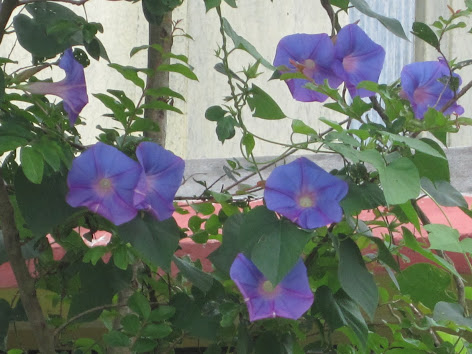
What a great walk, though! So peaceful. I headed out the way I've been running, but I saw so much more at a slower, easier pace. All kinds of flowers. People working in their rice paddies. A bunch of chicks running down the river rock road after their mother. A baby sitting alone on a porch, petting a little goat, and an old, wrinkly man snoozing under a banana tree. The road led further away from town, but there were farmhouses most of the way. I took a load of photos. Here's just a handful:



Time, I walked with an umbrella because, cloudy or not, the sun is intense. I got fewer stares than I usually do since I looked a little more normal, I guess, carrying sun protection like the locals. But people still clearly thought it odd that I was out walking with no particular destination or purpose in the hottest part of the day. I heard, "Whatchoo doing? Where you going?" from several people sitting in the shade. "Oh, just walking" was apparently pretty funny.
So, another thing I saw on my walk today—something I see every day here, actually, since it's across from the house—is a government school. Children wear uniforms at all schools, public and private. They're made to line up and chant and perform sort of a militaristic ritual in the schoolyard every morning. High caste don't mix with low caste, and most low caste children never go to school anyway. Physical punishment in the schools, while now officially against the law on paper, is still common, I'm told, and the law is usually unenforced. I read that well over half the children in Nepal are illiterate and never get an education.

I've written a little about the school Ingo founded at Shyauli Bazaar, at the rescue squad's base in the jungle. Initially, it was intended for children of the rescue workers. But then it expanded when children from area villages were brought in as well, including a higher caste (Brahmin) boy whose father had traded his son in exchange for fulfillment of a debt, and the boy worked as a slave. (I met him in Kathmandu. He's about 25 now and attends the university.) All of the children from the Riverside School have gone on to higher education, becoming doctors and nurses, teachers, accountants, artists, etc.—children who otherwise would not have had an education.
At the Riverside School, no physical punishment was allowed, and the policy was strictly enforced. The children didn't wear uniforms. There was no caste system, so the "untouchables" sat beside, played with, and roomed with the higher caste children. They were not made to stand in lines and chant. They played games and sports. Ingo says children learn better and faster when they're happy.
There aren't any students in Shyauli Bazaar now because of the war. The war is over, but it's had a lasting impact. Ingo had to hide the older students during the war because the Maoists would force them to join their army or kill them if they refused. They did kill a 14-year-old boy, the son of a man I met when we visited the compound.
I hate to end on a down note, so here's a little something to hopefully make you smile. This is a video just posted on the HRDSN YouTube channel, showing some of their SAR dogs practicing their skills....
http://www.youtube.com/watch?v=yixipMfB-7c
From the HRDSN YouTube page:
"These Nepalese SAR dogs and their junior handlers need sponsors for at least 1 more year of specialized training to be fully fit for all sorts of search & rescue missions. Nepal is a disaster prone country. Annually out here occur many large landslides and floods during the long rain season and thousands of remote villagers need our help.
"Nepal is also a hot spot for earthquakes and a large earthquake is already long overdue here if one studies the records of the country's earthquake history that give the clear indication that a huge one is happening at intervals of 60 to 70 years. This is due to the sub-continental Indian plate shift, gradually moving northward in the direction of the Tibetan plateau, raising the Himalayas upward and altering the landscape of Nepal in a dramatic way once in a lifetime of every Nepalese.
"What one sees in this video clip is practicing for earthquake victim search, negotiating difficult terrain and moving rubble. Its' just the beginning. More training has to be made at all sorts of locations--collapsed buildings, large landslides, etc.
"Those who want to sponsor a particular dog and its handler in this video clip please feel free to contact me for details. Youth Clubs, dog food and pet-store companies, private individuals, school classes--everyone is welcome to adopt a dog and its handler for a long-lasting relationship and many exciting pen pal exchanges, training reports etc. Transparent audit of use of the given donations will be provided regularly by us."
Kind regards,
Jit Bahadur Masrangi Magar
jitmagar34@yahoo.com
What a great walk, though! So peaceful. I headed out the way I've been running, but I saw so much more at a slower, easier pace. All kinds of flowers. People working in their rice paddies. A bunch of chicks running down the river rock road after their mother. A baby sitting alone on a porch, petting a little goat, and an old, wrinkly man snoozing under a banana tree. The road led further away from town, but there were farmhouses most of the way. I took a load of photos. Here's just a handful:


Time, I walked with an umbrella because, cloudy or not, the sun is intense. I got fewer stares than I usually do since I looked a little more normal, I guess, carrying sun protection like the locals. But people still clearly thought it odd that I was out walking with no particular destination or purpose in the hottest part of the day. I heard, "Whatchoo doing? Where you going?" from several people sitting in the shade. "Oh, just walking" was apparently pretty funny.
So, another thing I saw on my walk today—something I see every day here, actually, since it's across from the house—is a government school. Children wear uniforms at all schools, public and private. They're made to line up and chant and perform sort of a militaristic ritual in the schoolyard every morning. High caste don't mix with low caste, and most low caste children never go to school anyway. Physical punishment in the schools, while now officially against the law on paper, is still common, I'm told, and the law is usually unenforced. I read that well over half the children in Nepal are illiterate and never get an education.

I've written a little about the school Ingo founded at Shyauli Bazaar, at the rescue squad's base in the jungle. Initially, it was intended for children of the rescue workers. But then it expanded when children from area villages were brought in as well, including a higher caste (Brahmin) boy whose father had traded his son in exchange for fulfillment of a debt, and the boy worked as a slave. (I met him in Kathmandu. He's about 25 now and attends the university.) All of the children from the Riverside School have gone on to higher education, becoming doctors and nurses, teachers, accountants, artists, etc.—children who otherwise would not have had an education.
At the Riverside School, no physical punishment was allowed, and the policy was strictly enforced. The children didn't wear uniforms. There was no caste system, so the "untouchables" sat beside, played with, and roomed with the higher caste children. They were not made to stand in lines and chant. They played games and sports. Ingo says children learn better and faster when they're happy.
There aren't any students in Shyauli Bazaar now because of the war. The war is over, but it's had a lasting impact. Ingo had to hide the older students during the war because the Maoists would force them to join their army or kill them if they refused. They did kill a 14-year-old boy, the son of a man I met when we visited the compound.
I hate to end on a down note, so here's a little something to hopefully make you smile. This is a video just posted on the HRDSN YouTube channel, showing some of their SAR dogs practicing their skills....
http://www.youtube.com/watch?v=yixipMfB-7c
From the HRDSN YouTube page:
"These Nepalese SAR dogs and their junior handlers need sponsors for at least 1 more year of specialized training to be fully fit for all sorts of search & rescue missions. Nepal is a disaster prone country. Annually out here occur many large landslides and floods during the long rain season and thousands of remote villagers need our help.
"Nepal is also a hot spot for earthquakes and a large earthquake is already long overdue here if one studies the records of the country's earthquake history that give the clear indication that a huge one is happening at intervals of 60 to 70 years. This is due to the sub-continental Indian plate shift, gradually moving northward in the direction of the Tibetan plateau, raising the Himalayas upward and altering the landscape of Nepal in a dramatic way once in a lifetime of every Nepalese.
"What one sees in this video clip is practicing for earthquake victim search, negotiating difficult terrain and moving rubble. Its' just the beginning. More training has to be made at all sorts of locations--collapsed buildings, large landslides, etc.
"Those who want to sponsor a particular dog and its handler in this video clip please feel free to contact me for details. Youth Clubs, dog food and pet-store companies, private individuals, school classes--everyone is welcome to adopt a dog and its handler for a long-lasting relationship and many exciting pen pal exchanges, training reports etc. Transparent audit of use of the given donations will be provided regularly by us."
Kind regards,
Jit Bahadur Masrangi Magar
jitmagar34@yahoo.com
Watching Coconino County SAR From Nepal
Note: When I first wrote this post, there was a video available That video is no longer online, but this is what I wrote:
Here's a video from a recent SAR call in Flagstaff, in which Coconino County Sheriff's Search & Rescue, along with Flagstaff Fire and Guardian medics, carry out an injured hiker on Fatman's Loop.
Every time there's a call-out, I get an email, so I know what kinds of missions are happening. And later, some of my teammates fill me in on the details. They know how nosy... uh, how curious I am, even from 8,000 miles away. I also get emails about all the good trainings going on for general SAR, like advanced man-tracking and the three-day navigation boot camp, and for the technical rescue team, including mid-face patient care and mid-face litter scoops and a simulation drill of a search for a downed aircraft with injuries and evacuation. Fun stuff!
*sigh* I miss the team.
Nepal Update: Shyauli Bazaar
I'm back in Pokhara, lying in the little bit of shade there is on this concrete roof. A towel isn't nearly as comfortable as a beach chair or hammock would be, but at least there's a breeze out here. When the power went out around 11 a.m. and the ceiling fan stopped, my room suddenly became unbearable. I'm really looking forward to the rain to cool things down. It's been dry for a few days.
So, we went on our excursion to the jungle, and I loved it! I'm hoping we'll be able to return to Shyauli Bazaar soon, where I can wander down to the Middim Kohla (river) and soak my feet or sit under a gazebo, surrounded by flowers and fruit trees, and listen to the harmony of bird songs while I write or read. And of course there are all the wonderful SAR dogs to visit me for pats and rubs while I work or just relax and enjoy the sounds of the forest and the river below.
We left on Friday, seven of us in a jeep, for the bumpy, beautiful drive to the village of Bhorletar. Around 2 p.m, it started to rain—first a few fat drops and then an all-out deluge—and we drove through a road-turned-river that sometimes came up to the bottom of the vehicle's doors. With no defrost and the windows closed, the driver could barely see, and I could barely stand the heat. I was relieved when we arrived at the village and I could get out of that thing.


At Bhorletar, we were met by several porters, who'd walked from Shyauli Bazaar to help us carry our belongings, including a cooler full of perishables, which a small, thin man who looked to be in his 60s hoisted onto his back.
The walk was wet and wonderful. I was happy to be hiking. We walked through the village, then turned onto a trail that led us into the jungle, following alongside a little... I don't know what you'd call it... canal, I guess. Eventually, we descended to the Middim Kohla and walked along the valley floor, bordered on both sides by dark green, thickly forested hills, broken up now and then by terraces of yellow-green rice paddies.


We crossed strands of the Middim Kohla several times, and eventually I saw our destination, which I recognized by the blue metal roofs I'd seen in photos. We re-entered the jungle on a narrow path, then climbed concrete steps to a gated arbor.
After passing between two buildings of the Riverside School that I'd heard so much about, we were met by a herd of dogs—Maggie, Hunter, Aldo, Laxmi, Dunston, Helga, six growing Helga-Dunston puppies, and one black puppy (offspring of Susie, one of the two older dogs I didn't see)—and other members of HRDSN. I felt instantly at home.


We spent three nights at the HRDSN/Middim Kohla compound at Shyauli Bazaar. In addition to working on the book project, using the digital voice recorder to capture Ingo's stories in his own words, I explored the area within the compound walls. I wandered around the health care center, the Riverside School, the SAR dog training area, the Middim Kohla resort and guest lodging. I saw the fish ponds, greenhouses and gardens, solar panels, honey bee hives, and smoke house.
Ingo gave me a morning botanical tour of the property, where you can find pineapples, lemon and orange trees, avocado and mango trees, even coffee plants, to name just a few of the more than 100 fruiting trees on the property. We visited the former rabbit house, which will be used for something different in the future, and the commercial-sized fish pond, now empty for cleaning and leak-testing. As the day quickly heated up, we retreated to one of many well-placed gazebos for a late breakfast and more stories.


I also explored a bit outside the compound, wandering along the new road the Maoists are building, part of which runs right through HRDSN property. But the Maoists don't ask permission to do such things—they apparently just do what they like.
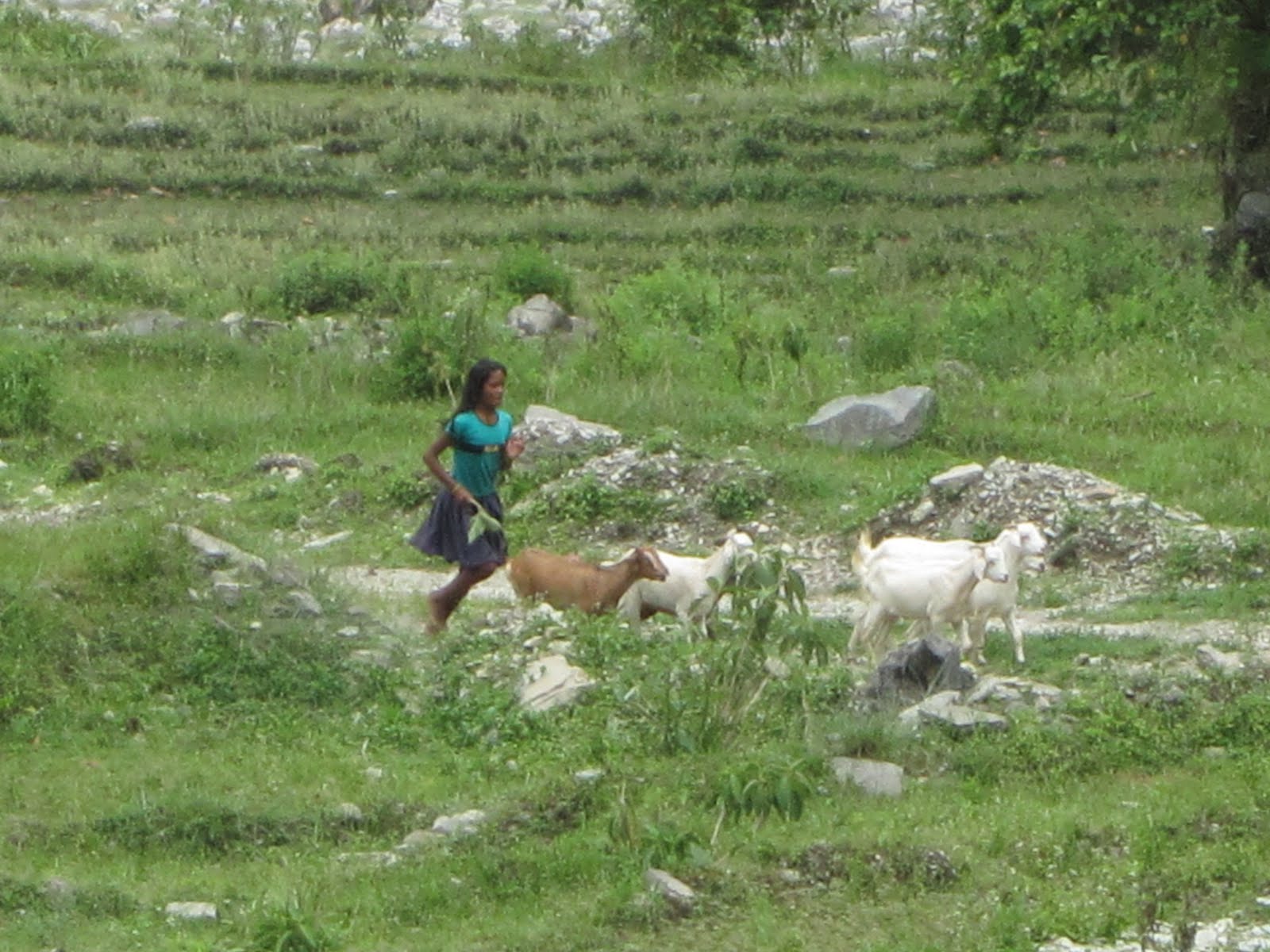
On my walk, I saw some of the village huts and people out and about, steering goats and water buffalo to preferred grazing spots, working in their gardens and rice paddies, climbing trees, walking to school an hour and a half away, and just sitting, watching the world go by... very slowly.

Oh, by the way... about the Middim Kohla Resort (which is more like a retreat, really): It was once the main source of non-mission income for the Himalaya Rescue Dog Squad, when trekkers on the inner route of the Annapurna Circuit would stop for meals and often stay, sometimes for days, weeks and, on a few occasions, months at the HRDSN compound. But there are very few trekkers nowadays, in large part due to the 10-year Moaist "People's War" and the continuing political instability. In fact, there's been a severe decline in tourism all over Nepal. So a vital source of income for HRDSN has been lost, which is why their financial problems are so severe right now and have been for some time. Hopefully, that will change in the near future.
On Monday, Ingo and I and three others walked (or trekked, I should say) back to meet the jeep. We went a different way than we'd come in, ending up at the village of Ram Bazaar and, this time, crossing a bridge over the widest part of the Middim Kohla, which I'm told will eventually fill the valley during the "real" rainy season.
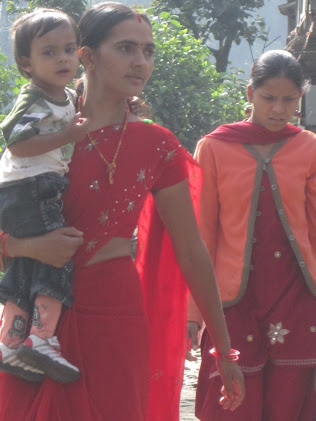
We walked early to avoid the hottest part of the day, then spent an hour in Ram Bazaar, waiting for our ride. Ingo chatted and laughed with local friends, while I people-watched as usual.
Update: Aubrey Sacco search
The search is still ongoing with no new clues that I know of. Read a recent article on CNN International: Lack of witnesses, records baffle dad searching for Nepal hiker
So, we went on our excursion to the jungle, and I loved it! I'm hoping we'll be able to return to Shyauli Bazaar soon, where I can wander down to the Middim Kohla (river) and soak my feet or sit under a gazebo, surrounded by flowers and fruit trees, and listen to the harmony of bird songs while I write or read. And of course there are all the wonderful SAR dogs to visit me for pats and rubs while I work or just relax and enjoy the sounds of the forest and the river below.
We left on Friday, seven of us in a jeep, for the bumpy, beautiful drive to the village of Bhorletar. Around 2 p.m, it started to rain—first a few fat drops and then an all-out deluge—and we drove through a road-turned-river that sometimes came up to the bottom of the vehicle's doors. With no defrost and the windows closed, the driver could barely see, and I could barely stand the heat. I was relieved when we arrived at the village and I could get out of that thing.


At Bhorletar, we were met by several porters, who'd walked from Shyauli Bazaar to help us carry our belongings, including a cooler full of perishables, which a small, thin man who looked to be in his 60s hoisted onto his back.
The walk was wet and wonderful. I was happy to be hiking. We walked through the village, then turned onto a trail that led us into the jungle, following alongside a little... I don't know what you'd call it... canal, I guess. Eventually, we descended to the Middim Kohla and walked along the valley floor, bordered on both sides by dark green, thickly forested hills, broken up now and then by terraces of yellow-green rice paddies.


We crossed strands of the Middim Kohla several times, and eventually I saw our destination, which I recognized by the blue metal roofs I'd seen in photos. We re-entered the jungle on a narrow path, then climbed concrete steps to a gated arbor.
After passing between two buildings of the Riverside School that I'd heard so much about, we were met by a herd of dogs—Maggie, Hunter, Aldo, Laxmi, Dunston, Helga, six growing Helga-Dunston puppies, and one black puppy (offspring of Susie, one of the two older dogs I didn't see)—and other members of HRDSN. I felt instantly at home.


We spent three nights at the HRDSN/Middim Kohla compound at Shyauli Bazaar. In addition to working on the book project, using the digital voice recorder to capture Ingo's stories in his own words, I explored the area within the compound walls. I wandered around the health care center, the Riverside School, the SAR dog training area, the Middim Kohla resort and guest lodging. I saw the fish ponds, greenhouses and gardens, solar panels, honey bee hives, and smoke house.
Ingo gave me a morning botanical tour of the property, where you can find pineapples, lemon and orange trees, avocado and mango trees, even coffee plants, to name just a few of the more than 100 fruiting trees on the property. We visited the former rabbit house, which will be used for something different in the future, and the commercial-sized fish pond, now empty for cleaning and leak-testing. As the day quickly heated up, we retreated to one of many well-placed gazebos for a late breakfast and more stories.


I also explored a bit outside the compound, wandering along the new road the Maoists are building, part of which runs right through HRDSN property. But the Maoists don't ask permission to do such things—they apparently just do what they like.
On my walk, I saw some of the village huts and people out and about, steering goats and water buffalo to preferred grazing spots, working in their gardens and rice paddies, climbing trees, walking to school an hour and a half away, and just sitting, watching the world go by... very slowly.
Oh, by the way... about the Middim Kohla Resort (which is more like a retreat, really): It was once the main source of non-mission income for the Himalaya Rescue Dog Squad, when trekkers on the inner route of the Annapurna Circuit would stop for meals and often stay, sometimes for days, weeks and, on a few occasions, months at the HRDSN compound. But there are very few trekkers nowadays, in large part due to the 10-year Moaist "People's War" and the continuing political instability. In fact, there's been a severe decline in tourism all over Nepal. So a vital source of income for HRDSN has been lost, which is why their financial problems are so severe right now and have been for some time. Hopefully, that will change in the near future.
On Monday, Ingo and I and three others walked (or trekked, I should say) back to meet the jeep. We went a different way than we'd come in, ending up at the village of Ram Bazaar and, this time, crossing a bridge over the widest part of the Middim Kohla, which I'm told will eventually fill the valley during the "real" rainy season.
We walked early to avoid the hottest part of the day, then spent an hour in Ram Bazaar, waiting for our ride. Ingo chatted and laughed with local friends, while I people-watched as usual.

Update: Aubrey Sacco search
The search is still ongoing with no new clues that I know of. Read a recent article on CNN International: Lack of witnesses, records baffle dad searching for Nepal hiker
Nepal Update: Back to Pokhara
Sometimes, I find it hard to believe I'm halfway (or thereabouts) round the world. And then I wake up
Sure, there are similarities everywhere you go, I suppose. Like, I don't know, people close their eyes when they sneeze. Dogs bark all night long if you let them. The moon looks the same. And poor people are often the most generous people.
But so much here is different than at home. The bathrooms. The food. Even store-bought Nabisco cookies taste different. The weather is different. The customs. The way people drive. The way people shake their head to mean "yes" (took me a while to figure that one out). As awesome as it is to be able to be here and experience Nepal, I've gotten a bit homesick from time to time.
Like today, when I was crouched down under the cold water, trying to rinse the soap out of my matted hair as a huge palmetto bug—the one that had been in the shorts I'd been wearing until I undressed for my... shower?—cowered in the corner of the bathroom. Just inches from me was the hole in the floor that is the toilet, where, so far, I've avoided dropping my brush or soap, which I foolishly keep setting down on the ledge just above said hole.
Yeah, at that time, I would have liked to beam myself home to stand under a hot, massaging shower after having actually sat down to pee. But, ah well, I'll have killer quads when I get home. Who needs Jazzercise when you've got hole-in-floor potties and shower faucets at about waist height? (Yes, there's one higher up, but the water just trickles out of that one. Not enough water to get the soap off of me or out of my hair.)
Do I sound like I'm complaining? Well, let me balance that out.
The hospitality here is amazing. My hosts really want me to be comfortable and always make sure I have enough to eat and drink. Jit always offers me tea when I go downstairs in the morning. And Phulmaya: nearly every day she comes to my room to see if I have laundry and washes it by hand. Ingo often asks, "Are you well?" (Maybe I don't look so happy when I'm deep in thought, which I am a lot, so maybe he worries.) I really appreciate how they've welcomed me and look out for my well-being. And Karna and Dikpal in Kathmandu, my trusted helpers and friends. I'll have to tell you more about them sometime.
Anyhow, I'm now back in Pokhara, on the quiet outskirts of town. Ingo and I flew back on Saturday—a 25-minute flight after sitting in Kathmandu traffic jams for two hours, made even worse than usual when the Maoists shut down streets in the middle of the city, forcing the taxi to take the long way around to the airport. It should have been a 15-minute ride.
So, it's back to quieter, lazier days at the house, with views of corn fields and rice paddies and grazing water buffalo. Every morning, I get up at dawn to check if I can see the amazing Himalaya and watch people working in their fields.

I do a circuit around the roof to see what I can see in all directions, then usually go back and read in bed for a while until the five boys downstairs go off to school. Then I go down to eat the early meal with Ingo. The days here tend to have a simple, easy pattern to them, punctuated only by occasional business in town and some book sessions, where Ingo talks (and talks) and I listen and scribble.
It looks like there will be a break in that routine when we head off to the jungle in a couple of days, to spend a little time at the rescue squad's base and dog training center in Shyauli Bazaar. It's a walled-in compound that includes a healthcare center, a school (although there are no students at this time), a resort that once catered to trekkers on the Annapurna Circuit (which has been re-routed away from there, thereby greatly impacting what was once a significant source of income for the squad), fish ponds, fruit trees, and vegetable gardens... and I don't know what else. I'm really looking forward to seeing this place that I've heard so much about. It's a significant part of the HRDSN story.
While I'm in Shyauli Bazaar, I won't have internet access. At one time, there was a good satellite connection, but that equipment, set up by two Englishmen who met Ingo while trekking through there about 10 years ago, was pretty much destroyed (or rendered useless anyway) by the Maoists during the war. At this point, there is no money to replace the missing parts. So, if you don't hear from me for a bit, it's just that I'm hangin' in the jungle near the Middim Khola (river).
I'm sure I'll have lots of photos and stories to share when I get back. In the meantime, here's one of my favorite recent photos, taken while stuck in Kathmandu traffic. I just love how the little girl smiled at me even before I held up my camera and pointed at it, asking her if I could take her picture. She nodded and kept smiling.

Sure, there are similarities everywhere you go, I suppose. Like, I don't know, people close their eyes when they sneeze. Dogs bark all night long if you let them. The moon looks the same. And poor people are often the most generous people.
But so much here is different than at home. The bathrooms. The food. Even store-bought Nabisco cookies taste different. The weather is different. The customs. The way people drive. The way people shake their head to mean "yes" (took me a while to figure that one out). As awesome as it is to be able to be here and experience Nepal, I've gotten a bit homesick from time to time.
Like today, when I was crouched down under the cold water, trying to rinse the soap out of my matted hair as a huge palmetto bug—the one that had been in the shorts I'd been wearing until I undressed for my... shower?—cowered in the corner of the bathroom. Just inches from me was the hole in the floor that is the toilet, where, so far, I've avoided dropping my brush or soap, which I foolishly keep setting down on the ledge just above said hole.
Yeah, at that time, I would have liked to beam myself home to stand under a hot, massaging shower after having actually sat down to pee. But, ah well, I'll have killer quads when I get home. Who needs Jazzercise when you've got hole-in-floor potties and shower faucets at about waist height? (Yes, there's one higher up, but the water just trickles out of that one. Not enough water to get the soap off of me or out of my hair.)
Do I sound like I'm complaining? Well, let me balance that out.
The hospitality here is amazing. My hosts really want me to be comfortable and always make sure I have enough to eat and drink. Jit always offers me tea when I go downstairs in the morning. And Phulmaya: nearly every day she comes to my room to see if I have laundry and washes it by hand. Ingo often asks, "Are you well?" (Maybe I don't look so happy when I'm deep in thought, which I am a lot, so maybe he worries.) I really appreciate how they've welcomed me and look out for my well-being. And Karna and Dikpal in Kathmandu, my trusted helpers and friends. I'll have to tell you more about them sometime.
Anyhow, I'm now back in Pokhara, on the quiet outskirts of town. Ingo and I flew back on Saturday—a 25-minute flight after sitting in Kathmandu traffic jams for two hours, made even worse than usual when the Maoists shut down streets in the middle of the city, forcing the taxi to take the long way around to the airport. It should have been a 15-minute ride.
So, it's back to quieter, lazier days at the house, with views of corn fields and rice paddies and grazing water buffalo. Every morning, I get up at dawn to check if I can see the amazing Himalaya and watch people working in their fields.

I do a circuit around the roof to see what I can see in all directions, then usually go back and read in bed for a while until the five boys downstairs go off to school. Then I go down to eat the early meal with Ingo. The days here tend to have a simple, easy pattern to them, punctuated only by occasional business in town and some book sessions, where Ingo talks (and talks) and I listen and scribble.
It looks like there will be a break in that routine when we head off to the jungle in a couple of days, to spend a little time at the rescue squad's base and dog training center in Shyauli Bazaar. It's a walled-in compound that includes a healthcare center, a school (although there are no students at this time), a resort that once catered to trekkers on the Annapurna Circuit (which has been re-routed away from there, thereby greatly impacting what was once a significant source of income for the squad), fish ponds, fruit trees, and vegetable gardens... and I don't know what else. I'm really looking forward to seeing this place that I've heard so much about. It's a significant part of the HRDSN story.
While I'm in Shyauli Bazaar, I won't have internet access. At one time, there was a good satellite connection, but that equipment, set up by two Englishmen who met Ingo while trekking through there about 10 years ago, was pretty much destroyed (or rendered useless anyway) by the Maoists during the war. At this point, there is no money to replace the missing parts. So, if you don't hear from me for a bit, it's just that I'm hangin' in the jungle near the Middim Khola (river).
I'm sure I'll have lots of photos and stories to share when I get back. In the meantime, here's one of my favorite recent photos, taken while stuck in Kathmandu traffic. I just love how the little girl smiled at me even before I held up my camera and pointed at it, asking her if I could take her picture. She nodded and kept smiling.

Nepal Update: Random Commentary and More People Pics
When you're riding in a taxi around Kathmandu, don't look ahead at what's coming at you or what you're moving toward (rapidly). Instead, direct your attention out your passenger side window and, while keeping all body parts well inside, take in the sights and sounds and marvel at how close the taxi can get to other vehicles, humans, and animals without actually touching them.
 And another tip: When you blow your nose after a day of wandering or driving around the city, don't inspect the tissue. It really is better not to know.
People don't just clear their throats here. They dig deep, seeing how much gunk they can remove from their esophaguses (esophagi?) and nasal passages in one fell swoop and deposit in the street. I just heard one such a clearing from my hotel room.
When you ride on the back of a motor bike around Nepal, as I did for the first time tonight, keep your mouth closed. Let's just leave it at that, shall we?
Today, I saw a guy riding a bicycle with a sofa strapped to the back. I kid you not.
Nepali women are STRONG.

"Cheek" in Nepali is not a part of the face or tooshie. It is apparently a very bad word.
I'm told it's rude to offer to help clean up after a meal in a Buddhist household, which is where I'm staying most of my time in Nepal. This could be habit-forming.
There is no such thing as "yak butter." A yak is a male. A female is a dri or a nuk. But the Nepalis use "yak butter" kind of as a joke for (rather, about) us Westerners. I mean, if you try to milk a yak, that's not a teat you're grabbing.
If you're claustrophobic or believe in overpopulation, check this out (took this at Boudha Stupa yesterday.):

A whistle-blowing, gesturing cop in the middle of traffic in Kathmandu doesn't accomplish anything whatsoever.

I've learned I don't like buffalo curd.
I will return to eating rice and dahl-bat morning and night as of tomorrow, when I return to Pokhara. But I'm not complaining.
Nepalis tell blonde jokes, too.

People don't just clear their throats here. They dig deep, seeing how much gunk they can remove from their esophaguses (esophagi?) and nasal passages in one fell swoop and deposit in the street. I just heard one such a clearing from my hotel room.
When you ride on the back of a motor bike around Nepal, as I did for the first time tonight, keep your mouth closed. Let's just leave it at that, shall we?
Today, I saw a guy riding a bicycle with a sofa strapped to the back. I kid you not.
Nepali women are STRONG.

"Cheek" in Nepali is not a part of the face or tooshie. It is apparently a very bad word.
I'm told it's rude to offer to help clean up after a meal in a Buddhist household, which is where I'm staying most of my time in Nepal. This could be habit-forming.
There is no such thing as "yak butter." A yak is a male. A female is a dri or a nuk. But the Nepalis use "yak butter" kind of as a joke for (rather, about) us Westerners. I mean, if you try to milk a yak, that's not a teat you're grabbing.
If you're claustrophobic or believe in overpopulation, check this out (took this at Boudha Stupa yesterday.):

A whistle-blowing, gesturing cop in the middle of traffic in Kathmandu doesn't accomplish anything whatsoever.

I've learned I don't like buffalo curd.
I will return to eating rice and dahl-bat morning and night as of tomorrow, when I return to Pokhara. But I'm not complaining.
Nepalis tell blonde jokes, too.
Twists and Turns of Events in Nepal
Hmm, where to start?
I'll give you a condensed version of some of the events that have taken place over the past week or so. Some details I do have to leave out, but perhaps I'll be able to write about them in the future. For now, though, with the search for Aubrey Sacco still underway, I have to be careful what I write.
I'll give you a condensed version of some of the events that have taken place over the past week or so. Some details I do have to leave out, but perhaps I'll be able to write about them in the future. For now, though, with the search for Aubrey Sacco still underway, I have to be careful what I write.
So, the man from the United Nations, who had been in contact with Ingo prior to this case, got involved with the search for Aubrey. This man was assisting by pulling resources together from within Nepal and around the globe, mobilizing international SAR experts before he even got here. He was on his way. But then a family tragedy occurred, which suddenly and understandably changed his plans, and he's out of the picture. At least, for now and probably for a long time to come.
Then there was the international SAR coordinator from the Red Cross, contacted by the man from the U.N., who was on her way here to oversee this mission. But then she was delayed en route to Nepal. When she did finally get here, she then left the country within 24 hours. That was primarily because of the Air India crash, which required her presence. So she too is out of the picture.
A number of international SAR volunteers also came to Nepal on their own dimes, but they have left, too. I never was able to meet or speak to any of them while they were here because I was not aware of their presence until they'd already gone.
And the Himalaya Rescue Dog Squad Nepal—the team I came here to meet and get to know so I could write about them—they've all now returned to their base in Shyauli Bazaar, along with the dogs. They'd used up all funds sent by sponsors from abroad to travel to and stay in Kathmandu, waiting to be mobilized for the Aubrey Sacco search. So they've now returned to the place in the jungle where they live and train, where they can be with their families, the other squad members, and the rest of the dogs, and have enough to eat from what's grown locally rather than rely on donations to survive in a city.
So, now it's me and Ingo left here in Kathmandu along with a young man from Manchester, England,who's been associated with HRDSN for about 10 years. He flew in from London a few days ago.
I hate to say something like, "Oh, you'll have to read the book" to find out more about Nik, but... well, I'm sure he'll be in the story, along with a number of other key characters in the history, present, and future of the squad and other things that will come of Ingo Schnabel's dream, which he put into action more than 20 years ago here in a very, shall we say, challenging country.
Ingo has met with Aubrey's father, brother, and their Nepali-American guide twice in Kathmandu and then went on two helicopter flights with them. During the second flight yesterday, they landed and spoke to locals in the Langtang area of the Himalaya. Having been here for two decades and on many searches in Langtang National Park, Ingo knows many of the local villagers, speaks their language (not straight Nepali), and knows their culture well enough to connect with them.
[Note: There used to be a video I could share with you that Ingo filmed during the second helicopter flight, but it's no longer available on YouTube or elsewhere that I've found.]
Sherpas from a local trekking company are also involved in this search, as are members of the Nepali army, at least to some degree. But what exactly the army's role is, I don't know. Apparently, they're not very communicative, so I've heard.
I need to make something clear: Nepal is a country where skilled search and rescue work cannot be done by locals without being paid up front. SAR is not funded by taxes, grants, or other government money like in the US and other much more affluent countries, where volunteer SAR professionals are able to spend their own money to participate and where bills associated with rescue—if there are any at all—can be sent out after the fact.
To the contrary, in Nepal, SAR work must be funded by the family and friends of the missing person and perhaps fundraising efforts on their part. The Nepalese have NO money to do this as a voluntary effort, and the conditions under which they usually work—in the highest peaks and jungles in the world—are extreme and inherently dangerous. These local people, both Nepali and long-time foreign transplants like Ingo, know the area, are familiar with the terrain, the flaura and fauna and other hazards, and the people, and they really are vital to a mission like this.
On a related note...
Today, I accompanied Ingo, Karna and Nik to see Chokyi Nima Rinpoche (I've also seen it spelled with an "m"—Rimpoche—and with a double "h"). Huh? you say. Well, a rinpoche is a lama (like the Dalai Lama is a lama) who's said to be clairvoyant. A psychic, if you will. I'm told they've been through the "cycle of life" and have chosen to return to help people. In addition to traditional search and rescue methods, it's common practice for Ingo and others to consult with these lamas when searches become particularly difficult, prolonged, and confusing. I'm told the level of accuracy is extremely high, but I have no personal knowledge of these things.
I've honestly never witnessed anything like what I did today. First, we met with a monk who led us to the rinpoche at Swoyambhu, a large monastery in the middle of Kathmandu, high on a hill. We had to walk to the left of many things on the way (good karma, apparently). We then removed our shoes and entered a small waiting room, where we showed Aubrey Sacco's photo to the monk and provided him with some basic information. He said the rinpoche would need just her name and birth year.
Soon, we were led into another tiny room, and there was the rinpoche, an old man dressed like any other monk. (Ingo later asked me if I noticed his unique ears—ears that only rinpoche have, he said—but I'd been too focused on his face.) In turn, we each crouched down so he could place a red ribbon around our necks, then took a seat on a pad on the floor.
Ingo asked each question in English, which Karna translated in Nepali to the monk. (Ingo speaks Nepali, but nowhere near as well as Karna.) The monk then translated to the rinpoche, who speaks a Tibetan language. The monk would remove three dice from a small container, shake them in his hand, sometimes blow on them, sometimes touch the hand with the dice, eyes closed, to his forehead. He would drop the dice back into the little dish and study them for a long moment and sometimes repeat the process before speaking. He would talk to the monk, and the translations would work in reverse. Sometimes, Karna didn't fully translate back into English because Ingo had understood the monk's Nepali words.
A rinpoche doesn't always speak in a very direct way, so I understand. For example, if someone is no longer alive, he may say something like, "He cannot see" or "I cannot see her," as if her spirit has left. (That was not said today.) Sometimes, a rinpoche may open his eyes and point and say "east" or "west" perhaps.
It'll be very interesting to see how this plays out and then to then compare reality to what the rinpoche said.
I wasn't able to photograph the rinpoche (I didn't even ask, but it would clearly have been inappropriate), but I did take a number of photos today at Swoyambhu and others at back in Kathmandu. Here are just a handful of many... most of which are of people:
.


FYI: I just found out that The TODAY Show on NBC will be airing an interview with Connie Sacco about Aubrey tomorrow morning. I believe that means Thursday morning in the US, since it's already Thursday morning here in Nepal. It will air between 7 and 9 am
What A Long, Strange Trip
The search for Aubrey Sacco continues. As of today, she's not been heard from in a month, not since she departed on a solo trek through Langtang National Park, which she intended to finish on or before April 30th. Aubrey never boarded her plane to Sri Lanka on May 15th. She was supposed to fly home to Colorado one week later, ending her six-month trip to southeast Asia.
I have some time to write now while we wait for an assignment from international SAR coordinator Valerie Chang from the Red Cross, who arrives in Nepal this evening. A number of groups and individuals from various parts of the world are now involved in the search, as well as Nepalis including sherpas from Langtang and the Himalaya Rescue Dog Squad Nepal (HRDSN). Aubrey's father, Paul Sacco, arrived yesterday and went directly to the embassy, I believe.
So, back to the trip from Pokhara to Kathmandu two days ago with Ingo, nine members of the HRDSN, and three beautiful dogs: Maggie and Hunter, both hounds from the US, and Aldo, a German shepherd donated from Germany.

It was the craziest bus trip of my life: eight hours to travel a distance of 200 kilometers. Everywhere I looked was a photo. Every scene was an essay waiting to be written. Every face a portrait. It was overwhelming, especially to someone like me who wishes she could capture every detail and share it all. For now, though, I'm reduced to simple phrases. Kind of an "I spy" of sorts as I leaned my face out the bus window for some hot, moving air and exhaust. I put my sunglasses on to spare my eyes from the dirt and dust.
I spy...
A small, shriveled old woman carrying a woven basket full of river rocks on her rounded back.
A boy herding goats inches from busses passing within inches of each other within inches of the steep drop into the valley below.
Terraced hillsides bright green with rice paddies and corn, rising above a brown river.
Men, women, and children gathered around roadside pipes and spigots, washing dishes, washing clothes, washing themselves.
Women in bright, beautiful clothing, with shiny black hair, working in a dirty construction site with dirty men.
Chickens crossing the busy road, and goats and dogs and cows and ducks.
Water buffalo.
A police checkpoint, where we have to stop.
Women in saris and high heels on the backs of motorbikes, their bright silky scarves billowing out behind them.
Mud houses with thatched roofs.
Garbage.
Piles of brick, piles of stone, piles of bags of concrete mix, sand bags.
Hills in front of bigger hills in front of mountains in front of bigger mountains disappearing into the white, steamy haze.
Flowers in fuchsia, red, yellow, white, lavender, and purple.
Trees ablaze in orange, their drooping branches heavy with large blooms.
Exotic women walking hand in hand and arm in arm, carrying parasols down flower- and trash-lined streets.
Shop after shop after shop after shop, all open-faced, so many of them so much alike.
Street vendors, squatting next to their wares, spread on cloths at the edge of the road;
Bright, silky, sparkling, woven, and woolen fabrics; baskets; shoes and sandals; piles of cabbage, tomatoes, melons, hot peppers; eggs in large, open cartons; beaded jewelry; clothing; purses; woven rugs; caged chickens; sacks of spices; bread; incense; sunglasses; sugary candies; warm bottled coke; white, purple, brown, and red potatoes; statuettes; cigarettes; bunches of green bananas, and heaps of mango.
Creaking carts pushed by weathered people.
Street dogs sleeping in the dirt, on the concrete steps, at the side of the road, in the road.
Women weaving.
Buildings, big and small, with uncovered windows and doors, leading into the blackness.
Traffic jams like puzzle pieces, inches apart.
Banana trees.
Old landslides ending abruptly at the narrow road they once covered.
People standing next to their immobile busses, cars, motorbikes, and trucks, waiting for an accident to clear
Busses bloated with breathing bodies driving through a blast furnace
Four-passenger cars with eight.
Gravel-laden trucks belching black smoke as they creep up the winding hill.
My life passing before my eyes as our bus passes another vehicle again, again on a blind curve.
Rock- and water-filled gorges disappearing into the jungle.
A man clipping his toenails.
A young boy with a dirty face and grease-covered hands fixing some sort of machine.
A man with a tube-shaped hat, carrying a large sack of something slung over his shoulder.
People spitting and snot-rockets.
Children playing a game without toys.
People sitting, doing nothing.
People staring back at me.
And that was the first ten minutes. 👀
.JPG)
Maggie and Me
I have some time to write now while we wait for an assignment from international SAR coordinator Valerie Chang from the Red Cross, who arrives in Nepal this evening. A number of groups and individuals from various parts of the world are now involved in the search, as well as Nepalis including sherpas from Langtang and the Himalaya Rescue Dog Squad Nepal (HRDSN). Aubrey's father, Paul Sacco, arrived yesterday and went directly to the embassy, I believe.
So, back to the trip from Pokhara to Kathmandu two days ago with Ingo, nine members of the HRDSN, and three beautiful dogs: Maggie and Hunter, both hounds from the US, and Aldo, a German shepherd donated from Germany.

It was the craziest bus trip of my life: eight hours to travel a distance of 200 kilometers. Everywhere I looked was a photo. Every scene was an essay waiting to be written. Every face a portrait. It was overwhelming, especially to someone like me who wishes she could capture every detail and share it all. For now, though, I'm reduced to simple phrases. Kind of an "I spy" of sorts as I leaned my face out the bus window for some hot, moving air and exhaust. I put my sunglasses on to spare my eyes from the dirt and dust.
I spy...
A small, shriveled old woman carrying a woven basket full of river rocks on her rounded back.
A boy herding goats inches from busses passing within inches of each other within inches of the steep drop into the valley below.
Terraced hillsides bright green with rice paddies and corn, rising above a brown river.
Men, women, and children gathered around roadside pipes and spigots, washing dishes, washing clothes, washing themselves.
Women in bright, beautiful clothing, with shiny black hair, working in a dirty construction site with dirty men.
Chickens crossing the busy road, and goats and dogs and cows and ducks.
Water buffalo.
A police checkpoint, where we have to stop.
Women in saris and high heels on the backs of motorbikes, their bright silky scarves billowing out behind them.
Mud houses with thatched roofs.
Garbage.
Piles of brick, piles of stone, piles of bags of concrete mix, sand bags.
Hills in front of bigger hills in front of mountains in front of bigger mountains disappearing into the white, steamy haze.
Flowers in fuchsia, red, yellow, white, lavender, and purple.
Trees ablaze in orange, their drooping branches heavy with large blooms.
Exotic women walking hand in hand and arm in arm, carrying parasols down flower- and trash-lined streets.
Shop after shop after shop after shop, all open-faced, so many of them so much alike.
Street vendors, squatting next to their wares, spread on cloths at the edge of the road;
Bright, silky, sparkling, woven, and woolen fabrics; baskets; shoes and sandals; piles of cabbage, tomatoes, melons, hot peppers; eggs in large, open cartons; beaded jewelry; clothing; purses; woven rugs; caged chickens; sacks of spices; bread; incense; sunglasses; sugary candies; warm bottled coke; white, purple, brown, and red potatoes; statuettes; cigarettes; bunches of green bananas, and heaps of mango.
Creaking carts pushed by weathered people.
Street dogs sleeping in the dirt, on the concrete steps, at the side of the road, in the road.
Women weaving.
Buildings, big and small, with uncovered windows and doors, leading into the blackness.
Traffic jams like puzzle pieces, inches apart.
Banana trees.
Old landslides ending abruptly at the narrow road they once covered.
People standing next to their immobile busses, cars, motorbikes, and trucks, waiting for an accident to clear
Busses bloated with breathing bodies driving through a blast furnace
Four-passenger cars with eight.
Gravel-laden trucks belching black smoke as they creep up the winding hill.
My life passing before my eyes as our bus passes another vehicle again, again on a blind curve.
Rock- and water-filled gorges disappearing into the jungle.
A man clipping his toenails.
A young boy with a dirty face and grease-covered hands fixing some sort of machine.
A man with a tube-shaped hat, carrying a large sack of something slung over his shoulder.
People spitting and snot-rockets.
Children playing a game without toys.
People sitting, doing nothing.
People staring back at me.
And that was the first ten minutes. 👀
.JPG)
Maggie and Me
Subscribe to:
Posts (Atom)