Now that this is in the news, I can tell you that the remains of a man our team and others searched for for 10 days in January and again in March of this year have been located.
I'm referring to the case of Mark Russell Irby, who disappeared from his home in rural Forest Lakes, Arizona, during what was supposed to be a short ATV ride on "The Loop" around the subdivision—something he often did—before he and his wife would return to their home in the city later that morning.
Mr. Irby, last seen wearing a denim shirt, jeans, and plastic Croc shoes, was not dressed for an extended ride in those winter conditions, and there was no less than three feet of snow in the area at the time.
The initial search involved 1,800 hours of manpower on foot and 20 hours by air. No tracks or clues were found at that time.
I wrote about the ongoing, extensive search in January:
1/4: 48 Hours And Counting
1/11: Where Is Mark?
And again in March, when his ATV was located about 10 miles from his home:
3/17: Three Ongoing Searches
And this is one of the latest news reports:
From the Arizona Daily Sun: Body Of Missing ATV Rider From Valley Found
His remains were found along the shore of Chevelon Canyon Lake, about 12 miles northwest of his cabin in Forest Lakes.
I'm waiting to see if more information is released to the public about this case. If I see anything new, I'll post it here. In the meantime, I'm thinking back on the whole thing—what I know of it, anyway—and thinking, I just don't get it. How did he get so far from home in those conditions?
I feel really sad for Mr. Irby and for his family and friends. I met some of them during the search and really wanted this to somehow have a positive outcome. But I'm glad that at least no one has to wonder "Where is Mark?" any longer.

These are my stories as a volunteer member of the Sheriff's Search and Rescue team in Coconino County, Arizona. I'll share what it's like to go from a beginner with a lot to learn to an experienced and, hopefully, valuable member of the team, as well as the missions, training, and other activities along the way.
11 Hours Of Sleep And I'm Back On Track
Eleven hours. That's what it took to make me feel human again. I've been running on fumes lately.
First, it was the 3 a.m. page on Saturday morning. I'd been asleep, to some degree at least, for three hours. When the pager went off, I was jolted awake but just lay there, pondering what to do. I was supposed to meet some of my teammates at 8:00 for the next phase of the Rock Rescue Academy, so maybe I'd skip this call-out.
But, of course, I had to phone in to see what was going on: four overdue hikers who'd left at 4 p.m. yesterday to walk a moderate, three-mile trail. I'd say they were overdue.
And I was still lying there in the dark when the pager went off a second time about 10 minutes later. I checked the code, thinking perhaps it was a 10-22 (a cancellation), but no, it was another try. Must not be getting much of a response.
Sure enough, when I called the SAR number again, I heard the identical message and, this time, left a message of my own. After testing my voice, which doesn't always work well when I'm awakened suddenly in the middle of the night, I think I mumbled something like, "This is Deb. I'm not sure what to do because of tech practice later today, but I'm responding." And as I was getting dressed for the mission, the pager went off for a third time. I called in yet again and heard a modified message from our Coordinator, stating that this mission "superseded" the technical rescue training.
About an hour and a half later, six of us were en route to the Blue Ridge area when a deputy located the four overdue hikers. So we made our U-turn and headed back to town, taking it easy so as to avoid a collision with an elk. The big creatures were everywhere in the early morning hours—hundreds of them grazing on the huge meadow that is Lower Lake Mary (unless it happens to have water in it, which is rather rare). They were also grazing along the road, sometimes standing in the road and running across it. I double-checked my seat belt and, from the back seat, kept my eyes peeled for large mammals.
So, Rock Rescue Academy (tech training) was back on. By the time I got home, I had just over two hours until I'd have to return to the SAR building. I figured it would be less painful to go without sleep than try to take a short nap, so I walked my dog and then played around on the computer until it was time to go. Soon, I was loading my gear into a SAR vehicle for the ride to the area where we'd be practicing.
At 5:30 p.m., I was home again after eight hours of training. During the field session, we put together what we'd learned about lowering, raising, and belaying into a working system, each of us rotating between stations, including command, main line, belay, edge, safety and attendant, with the attendant being the one who went over the edge. We practiced both "cold changeovers," when a lowering system is changed to a raising system while the attendant is securely on the ground below, and "hot changeovers," where the attendant is mid-face and must be raised back up. These skills took a lot of concentration on my part, especially being so sleepy, and needless to say, I was pretty well spent by the time training was over.
So, that was Saturday. On Sunday, we had another call-out, this one for a rescue on Mt. Humphreys.
Back to the SAR building I went and then up a mountain, helping carry the wheel for the litter up an off-trail route. We accidentally went a bit out of our way when we headed too far east and missed the intersection with the Humphreys Trail.
After correcting for our mistake and just as we were getting close to the patient's location at around 11,000 feet, we saw that the short-haul attempt was successful. Which was a very good thing. Given the subject's location on a steep, boulder-covered slope at the site of an old plane crash, and with the limited number of people we had between SAR personnel and Guardian medics, it would have been a very long and difficult litter carry. We all breathed a sigh of relief as we watched the helicopter fly off with the patient and our short haul- certified coordinator at the end of a long rope. Following a brief break, we turned around to bushwhack our way back down.
When the mission was over, my day was not. Not until about 11 p.m. when I finally crawled into bed and pulled the blankets over my head. I didn't budge until my dog insisted on going outside at 10:00 the next morning.
First, it was the 3 a.m. page on Saturday morning. I'd been asleep, to some degree at least, for three hours. When the pager went off, I was jolted awake but just lay there, pondering what to do. I was supposed to meet some of my teammates at 8:00 for the next phase of the Rock Rescue Academy, so maybe I'd skip this call-out.
But, of course, I had to phone in to see what was going on: four overdue hikers who'd left at 4 p.m. yesterday to walk a moderate, three-mile trail. I'd say they were overdue.
And I was still lying there in the dark when the pager went off a second time about 10 minutes later. I checked the code, thinking perhaps it was a 10-22 (a cancellation), but no, it was another try. Must not be getting much of a response.
Sure enough, when I called the SAR number again, I heard the identical message and, this time, left a message of my own. After testing my voice, which doesn't always work well when I'm awakened suddenly in the middle of the night, I think I mumbled something like, "This is Deb. I'm not sure what to do because of tech practice later today, but I'm responding." And as I was getting dressed for the mission, the pager went off for a third time. I called in yet again and heard a modified message from our Coordinator, stating that this mission "superseded" the technical rescue training.
About an hour and a half later, six of us were en route to the Blue Ridge area when a deputy located the four overdue hikers. So we made our U-turn and headed back to town, taking it easy so as to avoid a collision with an elk. The big creatures were everywhere in the early morning hours—hundreds of them grazing on the huge meadow that is Lower Lake Mary (unless it happens to have water in it, which is rather rare). They were also grazing along the road, sometimes standing in the road and running across it. I double-checked my seat belt and, from the back seat, kept my eyes peeled for large mammals.
So, Rock Rescue Academy (tech training) was back on. By the time I got home, I had just over two hours until I'd have to return to the SAR building. I figured it would be less painful to go without sleep than try to take a short nap, so I walked my dog and then played around on the computer until it was time to go. Soon, I was loading my gear into a SAR vehicle for the ride to the area where we'd be practicing.
At 5:30 p.m., I was home again after eight hours of training. During the field session, we put together what we'd learned about lowering, raising, and belaying into a working system, each of us rotating between stations, including command, main line, belay, edge, safety and attendant, with the attendant being the one who went over the edge. We practiced both "cold changeovers," when a lowering system is changed to a raising system while the attendant is securely on the ground below, and "hot changeovers," where the attendant is mid-face and must be raised back up. These skills took a lot of concentration on my part, especially being so sleepy, and needless to say, I was pretty well spent by the time training was over.
So, that was Saturday. On Sunday, we had another call-out, this one for a rescue on Mt. Humphreys.
Back to the SAR building I went and then up a mountain, helping carry the wheel for the litter up an off-trail route. We accidentally went a bit out of our way when we headed too far east and missed the intersection with the Humphreys Trail.
After correcting for our mistake and just as we were getting close to the patient's location at around 11,000 feet, we saw that the short-haul attempt was successful. Which was a very good thing. Given the subject's location on a steep, boulder-covered slope at the site of an old plane crash, and with the limited number of people we had between SAR personnel and Guardian medics, it would have been a very long and difficult litter carry. We all breathed a sigh of relief as we watched the helicopter fly off with the patient and our short haul- certified coordinator at the end of a long rope. Following a brief break, we turned around to bushwhack our way back down.
When the mission was over, my day was not. Not until about 11 p.m. when I finally crawled into bed and pulled the blankets over my head. I didn't budge until my dog insisted on going outside at 10:00 the next morning.

Our New SAR Building
We've finally moved. And that's a good thing.
For me, personally, I now have no more than a 10-minute drive (less if it's in the middle of the night and there's no traffic) from home to the building compared to The 105 across down. That's not the case for some team members who live on the far east side of Flagstaff, but I think the new location is better for more of us than not.
Also, we now have a lot more space, which will make moving things around and getting ready to head out for a mission much easier. And I'll be interested to see if our response time gets better, too.
For one thing, the new building is right behind the Sheriff's office and the rest of the law enforcement complex, so we'll no longer have the equipment and SAR vehicles at one end of town and our coordinators at the other. There's also much more room for training and practicing, like we did a few nights ago for the Rock Rescue Academy.
There's still much needed for the new building, not to mention the funds to pay for it, like a bay door (or is it two?), some interior block walls, plumbing and a bathroom, the completion of the offices and meeting room, etc. But at least we're now able to occupy the facility.
And here are a few photos:


If you look at the photos in my last entry, taken in our old SAR building (aka The 105 or SAR garage) while my teammates and I were practicing ascending, you can get a sense of the difference.
For me, personally, I now have no more than a 10-minute drive (less if it's in the middle of the night and there's no traffic) from home to the building compared to The 105 across down. That's not the case for some team members who live on the far east side of Flagstaff, but I think the new location is better for more of us than not.
Also, we now have a lot more space, which will make moving things around and getting ready to head out for a mission much easier. And I'll be interested to see if our response time gets better, too.
For one thing, the new building is right behind the Sheriff's office and the rest of the law enforcement complex, so we'll no longer have the equipment and SAR vehicles at one end of town and our coordinators at the other. There's also much more room for training and practicing, like we did a few nights ago for the Rock Rescue Academy.
There's still much needed for the new building, not to mention the funds to pay for it, like a bay door (or is it two?), some interior block walls, plumbing and a bathroom, the completion of the offices and meeting room, etc. But at least we're now able to occupy the facility.
And here are a few photos:


If you look at the photos in my last entry, taken in our old SAR building (aka The 105 or SAR garage) while my teammates and I were practicing ascending, you can get a sense of the difference.
Rock Rescue Practice
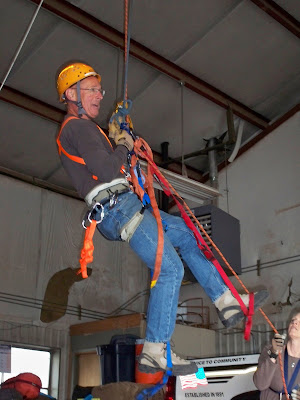
Well, our last mission on Friday night through Saturday morning took precedence over Saturday's Rock Rescue Academy field session, but a few of my teammates and I have been practicing. A time or two each week, some of us have been getting together at the SAR garage to rig up anchors and practice ascending. Here are a few photos from our last get-together:
Robert gets ready to go up the rope, while Bob performs a safety check.

Up goes Robert. Ascending is hard work, and each person has to figure out the technique that works best for them.

Bob goes next.
What? Who, me? Oh, sorry, I have no pictures of myself.😉 (Yes, Robert, I know you do... but I'm sure no one wants to see 'em!)
________________________________
In the news: Body, Thought To Be Missing Hiker, Found In Grand Canyon
Robert gets ready to go up the rope, while Bob performs a safety check.

Up goes Robert. Ascending is hard work, and each person has to figure out the technique that works best for them.

Bob goes next.

What? Who, me? Oh, sorry, I have no pictures of myself.😉 (Yes, Robert, I know you do... but I'm sure no one wants to see 'em!)
________________________________
In the news: Body, Thought To Be Missing Hiker, Found In Grand Canyon
Looking For The Boy Who Wasn't Lost
My keester is sore. (I know: thanks for sharing, Deb.) I just spent about eight hours on a quad, which felt like riding a bucking bronco. The Cinder Lakes OTV area is covered with big wave-like bumpety-bumps. Yeee-haaa! Ouch.
So, have I mentioned that I don't like riding quads? They're great tools for SAR, but I'd never ride one for... fun? No offense 'r' nothin' to those who do enjoy them, but it's just not my thing.
Anyhow, we were looking for a 10-year-old boy who'd disappeared from his family's campsite. At least, his mom didn't know where he was. Neither did the other relatives, friends, or caring strangers, both SAR and other campers, who were helping with the search throughout the night and early morning hours. The child had last been seen at about 7 p.m. Friday, running after two vehicles driven by extended family.
So, okay, does this sound odd to you? Part of a family group decides to go camp somewhere else. They leave for who-knows-where. A child from the group trails their vehicles as they drive off. Mom sees her son doing this but apparently turns and walks away. Next thing she knows, both the vehicles and her boy are gone. But did the boy get in one of the vehicles, or did he disappear on foot? And where did those vehicles go?
The answers to those questions weren't known for more than 12 hours, during which time numerous ground units and a DPS helicopter searched the area extensively. Finally, a few hours after sunrise, the helicopter spots two SUVs matching the description of those driven by the aunt and a cousin, a short way off one of a crazy network of cinder-covered roads. They land and confirm, thankfully, that the boy is with them.
But did those he was with ever turn on their cell phones and let anyone know they had the boy?
No, although there was coverage in the area.
Did they think to turn around and let Mom know her son was with them?
No.
Did they tell anyone where they were going? No, and they probably didn't even know, either.
Does any of this make sense?
Not to me.
I'm just glad the boy was with them. It would have been a whole different story had those vehicles been located but the child wasn't there.
Here's the brief newspaper story: Flagstaff Boy Found After 13 Hours Missing
_______________________________________
In other news:
Search For Missing Grand Canyon Hiker Scaled Back
Supai Reopens Monday (Things have changed since the August 2008 floods.)
So, have I mentioned that I don't like riding quads? They're great tools for SAR, but I'd never ride one for... fun? No offense 'r' nothin' to those who do enjoy them, but it's just not my thing.
Anyhow, we were looking for a 10-year-old boy who'd disappeared from his family's campsite. At least, his mom didn't know where he was. Neither did the other relatives, friends, or caring strangers, both SAR and other campers, who were helping with the search throughout the night and early morning hours. The child had last been seen at about 7 p.m. Friday, running after two vehicles driven by extended family.
So, okay, does this sound odd to you? Part of a family group decides to go camp somewhere else. They leave for who-knows-where. A child from the group trails their vehicles as they drive off. Mom sees her son doing this but apparently turns and walks away. Next thing she knows, both the vehicles and her boy are gone. But did the boy get in one of the vehicles, or did he disappear on foot? And where did those vehicles go?
The answers to those questions weren't known for more than 12 hours, during which time numerous ground units and a DPS helicopter searched the area extensively. Finally, a few hours after sunrise, the helicopter spots two SUVs matching the description of those driven by the aunt and a cousin, a short way off one of a crazy network of cinder-covered roads. They land and confirm, thankfully, that the boy is with them.
But did those he was with ever turn on their cell phones and let anyone know they had the boy?
No, although there was coverage in the area.
Did they think to turn around and let Mom know her son was with them?
No.
Did they tell anyone where they were going? No, and they probably didn't even know, either.
Does any of this make sense?
Not to me.
I'm just glad the boy was with them. It would have been a whole different story had those vehicles been located but the child wasn't there.
Here's the brief newspaper story: Flagstaff Boy Found After 13 Hours Missing
_______________________________________
In other news:
Search For Missing Grand Canyon Hiker Scaled Back
Supai Reopens Monday (Things have changed since the August 2008 floods.)
Subscribe to:
Posts (Atom)