About Coconino County

About Coconino County

Encompassing 18,661 square miles, Coconino County, Arizona, is the second largest county in the U.S. but one of the least populated. Our county includes Grand Canyon National Park, the Navajo, Havasupai, Hualapai and Hopi Indian Reservations, and the largest contiguous ponderosa pine forest in the world. Elevations range from 2,000 feet above sea level along the Colorado River to 12,633 feet at the summit of Mt. Humphreys in Flagstaff.

Disclosure: Some of the links on this site are affiliate links, and I may earn a commission if you click through and make a purchase.

Watching Coconino County SAR From Nepal

Note: When I first wrote this post, there was a video available That video is no longer online, but this is what I wrote:

Here's a video from a recent SAR call in Flagstaff, in which Coconino County Sheriff's Search & Rescue, along with Flagstaff Fire and Guardian medics, carry out an injured hiker on Fatman's Loop.

Every time there's a call-out, I get an email, so I know what kinds of missions are happening. And later, some of my teammates fill me in on the details. They know how nosy... uh, how curious I am, even from 8,000 miles away. I also get emails about all the good trainings going on for general SAR, like advanced man-tracking and the three-day navigation boot camp, and for the technical rescue team, including mid-face patient care and mid-face litter scoops and a simulation drill of a search for a downed aircraft with injuries and evacuation. Fun stuff!

*sigh* I miss the team.

Nepal Update: Shyauli Bazaar

I'm back in Pokhara, lying in the little bit of shade there is on this concrete roof. A towel isn't nearly as comfortable as a beach chair or hammock would be, but at least there's a breeze out here. When the power went out around 11 a.m. and the ceiling fan stopped, my room suddenly became unbearable. I'm really looking forward to the rain to cool things down. It's been dry for a few days.

So, we went on our excursion to the jungle, and I loved it! I'm hoping we'll be able to return to Shyauli Bazaar soon, where I can wander down to the Middim Kohla (river) and soak my feet or sit under a gazebo, surrounded by flowers and fruit trees, and listen to the harmony of bird songs while I write or read. And of course there are all the wonderful SAR dogs to visit me for pats and rubs while I work or just relax and enjoy the sounds of the forest and the river below.

We left on Friday, seven of us in a jeep, for the bumpy, beautiful drive to the village of Bhorletar. Around 2 p.m, it started to rain—first a few fat drops and then an all-out deluge—and we drove through a road-turned-river that sometimes came up to the bottom of the vehicle's doors. With no defrost and the windows closed, the driver could barely see, and I could barely stand the heat. I was relieved when we arrived at the village and I could get out of that thing.


At Bhorletar, we were met by several porters, who'd walked from Shyauli Bazaar to help us carry our belongings, including a cooler full of perishables, which a small, thin man who looked to be in his 60s hoisted onto his back.

The walk was wet and wonderful. I was happy to be hiking. We walked through the village, then turned onto a trail that led us into the jungle, following alongside a little... I don't know what you'd call it... canal, I guess. Eventually, we descended to the Middim Kohla and walked along the valley floor, bordered on both sides by dark green, thickly forested hills, broken up now and then by terraces of yellow-green rice paddies.


We crossed strands of the Middim Kohla several times, and eventually I saw our destination, which I recognized by the blue metal roofs I'd seen in photos. We re-entered the jungle on a narrow path, then climbed concrete steps to a gated arbor.

After passing between two buildings of the Riverside School that I'd heard so much about, we were met by a herd of dogs—Maggie, Hunter, Aldo, Laxmi, Dunston, Helga, six growing Helga-Dunston puppies, and one black puppy (offspring of Susie, one of the two older dogs I didn't see)—and other members of HRDSN. I felt instantly at home.


We spent three nights at the HRDSN/Middim Kohla compound at Shyauli Bazaar. In addition to working on the book project, using the digital voice recorder to capture Ingo's stories in his own words, I explored the area within the compound walls. I wandered around the health care center, the Riverside School, the SAR dog training area, the Middim Kohla resort and guest lodging. I saw the fish ponds, greenhouses and gardens, solar panels, honey bee hives, and smoke house.

Ingo gave me a morning botanical tour of the property, where you can find pineapples, lemon and orange trees, avocado and mango trees, even coffee plants, to name just a few of the more than 100 fruiting trees on the property. We visited the former rabbit house, which will be used for something different in the future, and the commercial-sized fish pond, now empty for cleaning and leak-testing. As the day quickly heated up, we retreated to one of many well-placed gazebos for a late breakfast and more stories.


I also explored a bit outside the compound, wandering along the new road the Maoists are building, part of which runs right through HRDSN property. But the Maoists don't ask permission to do such things—they apparently just do what they like.

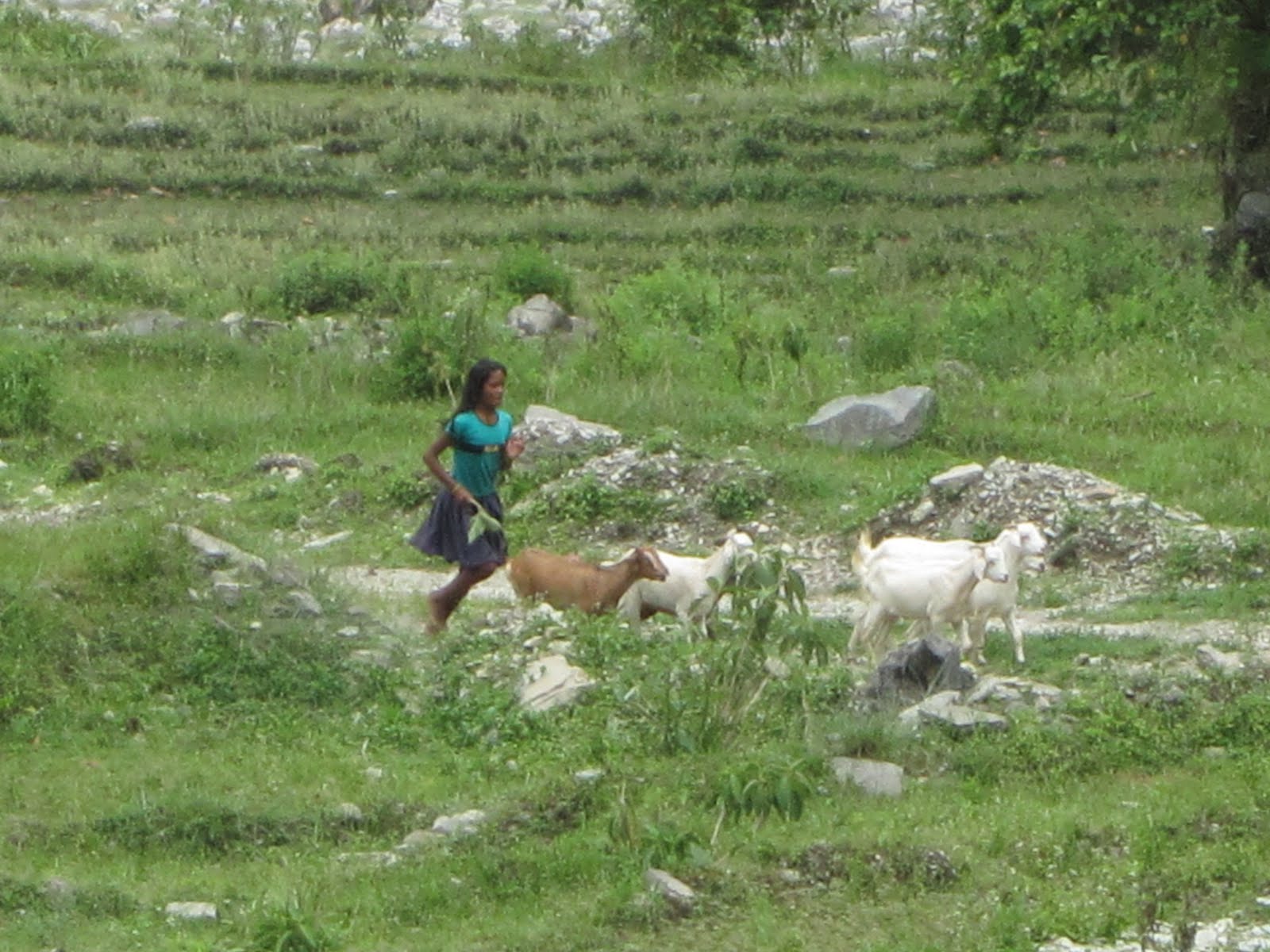
On my walk, I saw some of the village huts and people out and about, steering goats and water buffalo to preferred grazing spots, working in their gardens and rice paddies, climbing trees, walking to school an hour and a half away, and just sitting, watching the world go by... very slowly.


Oh, by the way... about the Middim Kohla Resort (which is more like a retreat, really): It was once the main source of non-mission income for the Himalaya Rescue Dog Squad, when trekkers on the inner route of the Annapurna Circuit would stop for meals and often stay, sometimes for days, weeks and, on a few occasions, months at the HRDSN compound. But there are very few trekkers nowadays, in large part due to the 10-year Moaist "People's War" and the continuing political instability. In fact, there's been a severe decline in tourism all over Nepal. So a vital source of income for HRDSN has been lost, which is why their financial problems are so severe right now and have been for some time. Hopefully, that will change in the near future.

On Monday, Ingo and I and three others walked (or trekked, I should say) back to meet the jeep. We went a different way than we'd come in, ending up at the village of Ram Bazaar and, this time, crossing a bridge over the widest part of the Middim Kohla, which I'm told will eventually fill the valley during the "real" rainy season.

We walked early to avoid the hottest part of the day, then spent an hour in Ram Bazaar, waiting for our ride. Ingo chatted and laughed with local friends, while I people-watched as usual.


Update: Aubrey Sacco search

The search is still ongoing with no new clues that I know of. Read a recent article on CNN International: Lack of witnesses, records baffle dad searching for Nepal hiker

Nepal Update: Back to Pokhara

Sometimes, I find it hard to believe I'm halfway (or thereabouts) round the world. And then I wake up

Sure, there are similarities everywhere you go, I suppose. Like, I don't know, people close their eyes when they sneeze. Dogs bark all night long if you let them. The moon looks the same. And poor people are often the most generous people.

But so much here is different than at home. The bathrooms. The food. Even store-bought Nabisco cookies taste different. The weather is different. The customs. The way people drive. The way people shake their head to mean "yes" (took me a while to figure that one out). As awesome as it is to be able to be here and experience Nepal, I've gotten a bit homesick from time to time.

Like today, when I was crouched down under the cold water, trying to rinse the soap out of my matted hair as a huge palmetto bug—the one that had been in the shorts I'd been wearing until I undressed for my... shower?—cowered in the corner of the bathroom. Just inches from me was the hole in the floor that is the toilet, where, so far, I've avoided dropping my brush or soap, which I foolishly keep setting down on the ledge just above said hole.

Yeah, at that time, I would have liked to beam myself home to stand under a hot, massaging shower after having actually sat down to pee. But, ah well, I'll have killer quads when I get home. Who needs Jazzercise when you've got hole-in-floor potties and shower faucets at about waist height? (Yes, there's one higher up, but the water just trickles out of that one. Not enough water to get the soap off of me or out of my hair.)

Do I sound like I'm complaining? Well, let me balance that out.

The hospitality here is amazing. My hosts really want me to be comfortable and always make sure I have enough to eat and drink. Jit always offers me tea when I go downstairs in the morning. And Phulmaya: nearly every day she comes to my room to see if I have laundry and washes it by hand. Ingo often asks, "Are you well?" (Maybe I don't look so happy when I'm deep in thought, which I am a lot, so maybe he worries.) I really appreciate how they've welcomed me and look out for my well-being. And Karna and Dikpal in Kathmandu, my trusted helpers and friends. I'll have to tell you more about them sometime.

Anyhow, I'm now back in Pokhara, on the quiet outskirts of town. Ingo and I flew back on Saturday—a 25-minute flight after sitting in Kathmandu traffic jams for two hours, made even worse than usual when the Maoists shut down streets in the middle of the city, forcing the taxi to take the long way around to the airport. It should have been a 15-minute ride.

So, it's back to quieter, lazier days at the house, with views of corn fields and rice paddies and grazing water buffalo. Every morning, I get up at dawn to check if I can see the amazing Himalaya and watch people working in their fields.


I do a circuit around the roof to see what I can see in all directions, then usually go back and read in bed for a while until the five boys downstairs go off to school. Then I go down to eat the early meal with Ingo. The days here tend to have a simple, easy pattern to them, punctuated only by occasional business in town and some book sessions, where Ingo talks (and talks) and I listen and scribble.

It looks like there will be a break in that routine when we head off to the jungle in a couple of days, to spend a little time at the rescue squad's base and dog training center in Shyauli Bazaar. It's a walled-in compound that includes a healthcare center, a school (although there are no students at this time), a resort that once catered to trekkers on the Annapurna Circuit (which has been re-routed away from there, thereby greatly impacting what was once a significant source of income for the squad), fish ponds, fruit trees, and vegetable gardens... and I don't know what else. I'm really looking forward to seeing this place that I've heard so much about. It's a significant part of the HRDSN story.

While I'm in Shyauli Bazaar, I won't have internet access. At one time, there was a good satellite connection, but that equipment, set up by two Englishmen who met Ingo while trekking through there about 10 years ago, was pretty much destroyed (or rendered useless anyway) by the Maoists during the war. At this point, there is no money to replace the missing parts. So, if you don't hear from me for a bit, it's just that I'm hangin' in the jungle near the Middim Khola (river).

I'm sure I'll have lots of photos and stories to share when I get back. In the meantime, here's one of my favorite recent photos, taken while stuck in Kathmandu traffic. I just love how the little girl smiled at me even before I held up my camera and pointed at it, asking her if I could take her picture. She nodded and kept smiling.