It's one thing to learn about search and rescue operations ("ops") and the Incident Command System (ICS) in the classroom and do table-top exercises with other SAR ops students—it's quite another to actually do those things... or assist, anyway... in the field.
Although I've responded to a few ops leader call-outs for mission startups (to help the coordinator before a general call-out is made), I had my first "real" chance to help with field ops during our team's recent mock search for the annual new member SAR Academy. Actually, I was asked to lead the exercise, and, though I didn't have the experience necessary to act as Incident Commander, even on a "pretend" mission, I agreed to step up and do it. I wanted to jump in and get some of that real ops experience, mock search or not.
The purpose of this field exercise, held at the end of the SAR Academy, is to give new members an idea of what an actual mission is like, beginning with receiving the call/email/text message call-out, phoning in to the SAR line with their name and badge number, and responding to the SAR building. Then it's a matter of getting all equipment, radios, and SAR vehicles ready to go and receiving a briefing and their strike team (or task force) assignments. From there, students work with their team members in the field, including navigating and handling radio communications, and documenting and relaying information about clues. Once the subject(s) is/are found, the students come up with an evacuation plan and move the subject(s) out of the field, back to base. Finally, they debrief and go through other aspects of wrapping up a mission, particularly the "hasty" search phase, which is when the majority of missing or overdue subjects are located. The field exercise gives new members a chance, with the help of experienced team members, to put together all the skills they've learned during the SAR Academy and put them to practical use.
All I can say is, I'm grateful for the help and support of several members of the team who have a lot more ops experience than I do. While I was able to facilitate the planning (I'm good at sending out emails!) and help carry out this field exercise, which was a search for two overdue subjects in a wooded area near Flagstaff, there was much I didn't know how to do or that would have taken me too long to figure out on my own. For example, I didn't know how to work the computer program to create the specific maps we needed for the briefing packets; I would have taken a lot longer to come up with assignments for all of the field teams, both ground SAR and mounted, on my own; and I would have been overwhelmed as the IC (incident commander). So many things going on all at once, and many of those things in constant flux.
To expect that a mission—even a mock mission where we plan the locations for our "missing" subjects to be found—will go off just as planned from beginning to end would be to expect the nearly impossible, as I see it. I could lie there in bed at 2 a.m., as I did one night when I couldn't sleep, and imagine the whole thing, from call-out to debrief at the conclusion of the search, as a nice, orderly mental movie. In reality, things didn't go quite as I'd imagined (or planned), starting right from that call-out, which was sent to new members and those experienced team members who'd volunteered to help as "observers."
After the call-out was finally made at 8:10 a.m., it took longer than expected for everyone to arrive at the SAR building. And an assignment was changed last minute. And the unpaved Forest Service road the mounted unit members had to drive with their horse trailers and horses to get to their starting point turned out to be in much worse shape than expected (compared to the last time any of us were out there). And the shuttling of ground-pounder strike teams was rather complex and time-consuming. (Did I mention some of those roads are really bad?) And that "jeep track" on the map—the one where I instructed one of our subjects to leave a clue she was given and then, further along that jeep track, to hang out with her mock ankle injury and wait to be found and rescued—well, that jeep track wasn't really there anymore, so she couldn't find it. And the list goes on.
One thing I had some good practice at during this process was delegating. In some cases, I didn't have to ask. The team members who helped me with the planning gladly offered to take on tasks, and I went from one person to the other, looking over their shoulders, helping where I could, asking questions, and listening and watching and learning. Then, when the call-out was made, we had the added help from those experienced observers, who gave direction to the new folks as they arrived at the building, helped them understand their assignments and find their starting points on the maps, directed them in loading equipment and preparing to leave the bay, and assisted with all other aspects of the mission.
Me? Oh, I ran around. A lot. I shuttled searchers and eventually the Stokes litter and medical supplies to the evac team. And I assisted at Incident Command as information came in over the radio and teams in the field asked for direction as the search went on. I didn't do any hiking that day, but, wow, when I got home I felt like I'd walked miles.
All in all, the field exercise went well, and I think (hope) all new members got something useful out of it. Actually, I'm sure they did, including better understanding the fact that we all need to be flexible during missions because things are continuously changing and that sometimes we get assignments that may seem "boring" or "useless" but are actually vital to the mission, including doing containment and also finding out where a missing person is not. There were new members who actually said those things to me—that the field exercise helped them realize those aspects of search and rescue—and that definitely was good to hear.
So, I'm holding on to the briefing packet and the notes I made this time around and want to participate with planning and ops again next year, hopefully by then with more confidence and skills I can bring to the table.
One thing's for sure: I now have an even better appreciation for how challenging SAR ops is and really admire those who can handle sometimes very stressful and complex missions so well. It can be easy to comment from a searcher's point of view on how things are managed and carried out, but putting myself even just somewhat in the position of a SAR ops leader has given me a whole new perspective. Not to mention the desire to get a whole lot better at it.

These are my stories as a volunteer member of the Sheriff's Search and Rescue team in Coconino County, Arizona. I'll share what it's like to go from a beginner with a lot to learn to an experienced and, hopefully, valuable member of the team, as well as the missions, training, and other activities along the way.
Welcome, Tank! Our Team's Newest Certified, 4-Legged Member
 | |
| Tank (Used with permission from D. Christian) |
Isn't he a beauty? This is Tank, a two-year-old bloodhound–Labrador retriever mix, owned and loved by his handler, Diane, who's been involved with search and rescue for many years. Diane is retired from law enforcement, where she worked with SAR and police detection dogs for explosives and tracking. She got her first tracking dog in 1992. Tank is her third hound.
Together, they recently passed the highest K-9 trailing certification in the country: NASAR SARTECH Canine Trailing I.
For information on the various NASAR Canine certifications and what those tests entail, see NASAR Canine SAR or go directly to their PDF file on Canine Certification Programs.
Tank, a rescue dog out of a shelter in Los Angeles, is actually a tracking canine with a trailing certification. This means that our team is now fortunate to have both a tracking/trailing dog and three cross-trained air-scent/human remains detection dogs to assist with our missions. All the dogs and their handlers train (which is like play time to the dogs) at least a few times each week to keep up their skills and their fitness.
For those who aren't familiar with the different types of SAR K9s and the way they work, here's a basic overview:
Tracking Dogs — This type of SAR dog works from a scent article that has the subject's odor on it, such as a piece of clothing or hat, a pillow case, a hair brush, and so forth. (It's best if the handler collect the scent article so it's done correctly and not contaminated with someone else's scent.) The dog picks up the specific human scent from that item and uses it to locate the path that person took. Tracking dogs generally work on a long lead, taking the handler to the subject by following the missing person's footsteps.
Trailing Dogs — Trailing dogs work in a manner that's very similar to tracking dogs. A scent article is carefully obtained in order to isolate the missing person's scent. The search dog then smells the scent article and uses that smell to find and follow the path the person took. With trailing dogs, though, the dog might veer off the missing person's actual track, cutting corners and using the wind to its advantage. Trailing dogs generally work on a 20- to 30-foot lead.
Air Scent Dogs — Unlike tracking and trailing dogs, air scent dogs work off-lead, ranging back and forth to pick up human scent. ANY human scent, that is, which is why it's important to test wind direction and, as much as possible, keep other people (i.e., searchers) downwind of the dog while its searching an area. Ranging often takes the air-scent dog out of the handler's sight for a time, so the handler must trust the dog and wait for an alert. Once the dog picks up human scent, they'll move in toward the source and then give an alert to the handler. That alert might be barking while staying with the source of the scent or might be done by returning to the handler and somehow conveying to that person, "Follow me!" The dog then leads the handler to the subject.
In general, air scent dogs are not scent-discriminating the way tracking/trailing dogs are, so scent articles are not used. Rather, the air scent dog will seek out any human scent and alert the handler. If the human who's located is not the subject, the handler will reward the dog for the find and then give the command to continue searching.
There are variations to the above, but those are the basics.
Here's another shot of Tank at work...
 |
| Photo used with permission by D. Christian |
In other Coconino County SAR news, these are missions our team has recently been involved with:
Climber Injured in Oak Creek Fall: A 43-year-old Flagstaff man fell about 40 feet while climbing near the Oak Creek Canyon overlook on Monday. A tourist saw the man fall and called 911. A technical rescue followed, with cooperation by crews from Coconino County Search & Rescue, the Sedona Fire Department, and the Highlands Fire Department.
Crews Search Oak Creek for Missing Minnesota Man: 27-year-old Shaun Rentz of Minnesota was reported missing after he failed to meet with friends over the weekend and then didn't show up to move in with friends at their new home in the Twin Cities on Monday. His abandoned vehicle was then located near Flagstaff, Arizona, at the Oak Creek Canyon Overlook parking area, later that same day. Here's another article with additional information and a photo of Shaun: Car of Missing Twin Cities Man Found in Arizona.
Any questions about these or other SAR missions in Coconino County should be directed to the Coconino County Sheriff's Office.

A Change of SAR Plans -- Community Education to a Rescue Instead
I was supposed to go to a day camp with three other SAR members, to help teach kids ranging in age from five to 12 how to use a compass, what makes a "good pack" versus a "bad pack" (that is, gear you should bring on a hike versus stuff to leave at home), and how to not get lost or to "get found" if you do. We went to this summer camp last year, and our program was a hit with campers and camp leaders alike, so they'd asked us to come back.
And I was going to, until right before I was supposed to leave the house. That's when there was a call-out for a rescue, possibly technical the message said, in the Dorsey Springs area of Sycamore Canyon.
So, per the request of the deputy coordinating the mission, I bailed on my teammates going to the camp and responded to the rescue instead.
Late the night before, there had been a call-out for the search for this 41-year-old overdue hiker who now needed rescue. I hadn't responded to that call because of my prior commitment to the camp program in the morning. Apparently, this man was at least a day overdue when a concerned family member had reported him missing, and his vehicle had been located by deputies at the Dorsey Springs trailhead. Just after dawn, searchers had found him down in the canyon, severely dehydrated, weak, and disoriented.
By the time those of us responding to the rescue call later that morning arrived at the trailhead, the hiker had been hydrated and slowly walked with aid partway up the trail. At that point, the man said he couldn't walk anymore. The two deputies who were with him requested assistance and more water. Several of us hiked in with supplies to meet up with them.
When we arrived, the man was sitting under a tree. He drank some Gatorade and spoke to one of our teammates, who's a paramedic. The man said he was okay except for being dehydrated and clearly explained what had happened over the past several days. The searchers who'd found first his backpack and then, maybe a few hundred yards away, the subject filled us in on his state of mind and actions at the time he was located. He'd made quite an improvement after having something to drink and eat.
Sadly, the two dogs he'd brought on the multi-day hike—adult, black-colored boxers, a male and a female—were nowhere to be found. They'd stopped following him at least a day and a half earlier and laid down in the shade. Had they had enough left in them to find their way back to the last water source they'd been at with the man? I hoped they had. And that they'd survive long enough for someone to find them. I was preoccupied by those thoughts as I watched the short-haul procedure, when the man was air-lifted to the trailhead. He refused medical transport by the waiting ambulance.
Lessons for the day: Carry a lot of water if hiking in hot desert canyons during the summer. Hike early and hike late, and rest in the shade during the day. Know where the water sources are, and make sure they currently have water in them. Call the Forest Service or whichever agency oversees the area and check on those sources. For Sycamore Canyon, that would be:
Coconino Forest Supervisor's Office
1824 S. Thompson St.
Flagstaff, AZ 86001
(928) 527-3600
Fax: (928) 527-3620
Update: I've been told that one of the two dogs that had been lost in the canyon has been located alive and returned home. The other has not been found yet. So keep an eye out if you're down there!
And I was going to, until right before I was supposed to leave the house. That's when there was a call-out for a rescue, possibly technical the message said, in the Dorsey Springs area of Sycamore Canyon.
So, per the request of the deputy coordinating the mission, I bailed on my teammates going to the camp and responded to the rescue instead.
Late the night before, there had been a call-out for the search for this 41-year-old overdue hiker who now needed rescue. I hadn't responded to that call because of my prior commitment to the camp program in the morning. Apparently, this man was at least a day overdue when a concerned family member had reported him missing, and his vehicle had been located by deputies at the Dorsey Springs trailhead. Just after dawn, searchers had found him down in the canyon, severely dehydrated, weak, and disoriented.
By the time those of us responding to the rescue call later that morning arrived at the trailhead, the hiker had been hydrated and slowly walked with aid partway up the trail. At that point, the man said he couldn't walk anymore. The two deputies who were with him requested assistance and more water. Several of us hiked in with supplies to meet up with them.
When we arrived, the man was sitting under a tree. He drank some Gatorade and spoke to one of our teammates, who's a paramedic. The man said he was okay except for being dehydrated and clearly explained what had happened over the past several days. The searchers who'd found first his backpack and then, maybe a few hundred yards away, the subject filled us in on his state of mind and actions at the time he was located. He'd made quite an improvement after having something to drink and eat.
Sadly, the two dogs he'd brought on the multi-day hike—adult, black-colored boxers, a male and a female—were nowhere to be found. They'd stopped following him at least a day and a half earlier and laid down in the shade. Had they had enough left in them to find their way back to the last water source they'd been at with the man? I hoped they had. And that they'd survive long enough for someone to find them. I was preoccupied by those thoughts as I watched the short-haul procedure, when the man was air-lifted to the trailhead. He refused medical transport by the waiting ambulance.
Lessons for the day: Carry a lot of water if hiking in hot desert canyons during the summer. Hike early and hike late, and rest in the shade during the day. Know where the water sources are, and make sure they currently have water in them. Call the Forest Service or whichever agency oversees the area and check on those sources. For Sycamore Canyon, that would be:
Coconino Forest Supervisor's Office
1824 S. Thompson St.
Flagstaff, AZ 86001
(928) 527-3600
Fax: (928) 527-3620
Update: I've been told that one of the two dogs that had been lost in the canyon has been located alive and returned home. The other has not been found yet. So keep an eye out if you're down there!
An All-Night Search in Ashfork
I was tired. When the call came from SAR, I was sitting in a Lay-Z-Boy being very lazy. It was around 9 p.m., and I was ready for bed. I listened to the short message about the mission, looked at the text that came through seconds later, and put the phone back down. "Not this time," I told Jeremy.
But then, two minutes later, Cindy, our K9 handler, called me directly. Our coordinator was requesting the dogs, and would I be her backer, she asked. *sigh* Okay, for Cindy I would go. So, I met her at the SAR building about 20 minutes later and loaded my gear into her vehicle to the tune of three excited golden retrievers. They'd already hiked several miles earlier that day, but they were still rearing to go. The two of us two-legged creatures, though? Not so much.
We got our brief briefing—a 70-year-old gentleman with what sounded like a moderate level of dementia (possibly Alzheimer's) had now been missing nearly 24 hours after driving someone else's vehicle to the very rural area where he lives, then left the vehicle in the trees near a dirt road and walked away. This was not the first time he'd gotten lost while trying to go home.
Cindy and I left the SAR building ahead of our teammates as they got some additional gear ready. We were supposed to rendezvous with two deputies who were at the location where the abandoned vehicle had been found. That was now the initial planning point (IPP). From there, we'd begin our search with the dogs, and the other volunteers would soon follow.
When we found our way to the waiting deputies through a network of dusty roads and jackrabbits (actually managed not to hit any as they streaked across the murky beams of our headlights), we consulted with them (the deputies that is, not the rabbits) about what had and had not been found and determined the area we thought was the highest probability. Then it was time to let the excited dogs out to do their thing: search.
"Your assignment," Cindy half-whispered to the three wet noses that turned her way, "should you choose to accept it... is..." After the usual dramatic pause, she shouted, "Go find!" Three fuzzy golden tails shot off into the dark as we followed much more slowly. We would walk the grid, and the dogs would range around us as we moved.
As the backer, it was my job to handle radio communications, navigate the grid within our search area given the information from Cindy about wind direction and her instructions about how she wanted to work the dogs, and keep us all on track. "Go a little more left," I would say, then, "Turn a bit more to the right," as I stayed behind and to the side of Cindy, trying to make a pretty little grid pattern on my GPS while still looking around.
In the light of my headlamp, obscured by the dust we were kicking up as we walked across bone-dry ground, I tried to manage the topo map and my GPS without walking into a pinion, juniper, or ponderosa pine or tripping on rocks, dips, and forest debris. Needless to say, on more than a few occasions I had to say to Cindy, "I need to stop to get this figured out. I can't walk and try to read a map and GPS at the same time." Yeah, I was moving and searching and calling the subject's name, but I was cranky, too.
I was also still frustrated because it had taken a while for me to get myself oriented that night, out there in the fairly flat and, aside from one major drainage, often featureless, forested terrain. Even when I had my map oriented to the way I was facing, the mental picture was alluding me. And the frustration only confused me more.
After talking to myself, though—aloud for anyone to hear—and working it out ("okay, this is that road," I said, pointing toward my feet and then to the map, "and this is that road... so, okay, we're right here, and we want to go that way...") the mental picture finally appeared and cleared. So on my mark, we were ready to go.
And then Cindy gave the dogs their little "your assignment" shpeel. (See, I still have things all messed up.)
Anyhow, this whole K9 handler/backer thing is so much about communication, and though we sometimes get cranky—one or both of us—Cindy and I really have learned how to talk things out, to problem-solve and reason and get back on track when we get a bit off. We've also worked through temporary miscommunications and misunderstandings without getting all unglued. The more we work together, the better we become as a team. I like that!
Well, long story just a little shorter, we did lots of walking throughout the night and into the next morning. We also did lots of calling out for the subject. The dogs worked their tails off. And we saw, to our pleasure, that one of Cindy's dogs, who'd originally been trained as a tracking/trailing dog and later switched over to air-scenting, reverted to tracking/trailing when the opportunity—human scent on the ground—presented itself. Sure enough, we found footprints. Good dog!
But we weren't the ones who actually found the subject. It was a friend of his who found him, safe and asleep in the corner of a room in his own home, just after Cindy and I were released to return to Flagstaff later that morning. The man we'd been looking for for nearly 12 hours had apparently found his house sometime during the night, after the friend, who was supposed to stay in case the man showed up, had left to return to his own home.
Well, all was well enough that ended well. The man was okay and, for now at least, home safe.
A couple of hours later, after insisting to Jeremy that I can't sleep during the day, I was fast asleep on the living room floor.
But then, two minutes later, Cindy, our K9 handler, called me directly. Our coordinator was requesting the dogs, and would I be her backer, she asked. *sigh* Okay, for Cindy I would go. So, I met her at the SAR building about 20 minutes later and loaded my gear into her vehicle to the tune of three excited golden retrievers. They'd already hiked several miles earlier that day, but they were still rearing to go. The two of us two-legged creatures, though? Not so much.
We got our brief briefing—a 70-year-old gentleman with what sounded like a moderate level of dementia (possibly Alzheimer's) had now been missing nearly 24 hours after driving someone else's vehicle to the very rural area where he lives, then left the vehicle in the trees near a dirt road and walked away. This was not the first time he'd gotten lost while trying to go home.
Cindy and I left the SAR building ahead of our teammates as they got some additional gear ready. We were supposed to rendezvous with two deputies who were at the location where the abandoned vehicle had been found. That was now the initial planning point (IPP). From there, we'd begin our search with the dogs, and the other volunteers would soon follow.
When we found our way to the waiting deputies through a network of dusty roads and jackrabbits (actually managed not to hit any as they streaked across the murky beams of our headlights), we consulted with them (the deputies that is, not the rabbits) about what had and had not been found and determined the area we thought was the highest probability. Then it was time to let the excited dogs out to do their thing: search.
"Your assignment," Cindy half-whispered to the three wet noses that turned her way, "should you choose to accept it... is..." After the usual dramatic pause, she shouted, "Go find!" Three fuzzy golden tails shot off into the dark as we followed much more slowly. We would walk the grid, and the dogs would range around us as we moved.
As the backer, it was my job to handle radio communications, navigate the grid within our search area given the information from Cindy about wind direction and her instructions about how she wanted to work the dogs, and keep us all on track. "Go a little more left," I would say, then, "Turn a bit more to the right," as I stayed behind and to the side of Cindy, trying to make a pretty little grid pattern on my GPS while still looking around.
In the light of my headlamp, obscured by the dust we were kicking up as we walked across bone-dry ground, I tried to manage the topo map and my GPS without walking into a pinion, juniper, or ponderosa pine or tripping on rocks, dips, and forest debris. Needless to say, on more than a few occasions I had to say to Cindy, "I need to stop to get this figured out. I can't walk and try to read a map and GPS at the same time." Yeah, I was moving and searching and calling the subject's name, but I was cranky, too.
I was also still frustrated because it had taken a while for me to get myself oriented that night, out there in the fairly flat and, aside from one major drainage, often featureless, forested terrain. Even when I had my map oriented to the way I was facing, the mental picture was alluding me. And the frustration only confused me more.
After talking to myself, though—aloud for anyone to hear—and working it out ("okay, this is that road," I said, pointing toward my feet and then to the map, "and this is that road... so, okay, we're right here, and we want to go that way...") the mental picture finally appeared and cleared. So on my mark, we were ready to go.
And then Cindy gave the dogs their little "your assignment" shpeel. (See, I still have things all messed up.)
Anyhow, this whole K9 handler/backer thing is so much about communication, and though we sometimes get cranky—one or both of us—Cindy and I really have learned how to talk things out, to problem-solve and reason and get back on track when we get a bit off. We've also worked through temporary miscommunications and misunderstandings without getting all unglued. The more we work together, the better we become as a team. I like that!
Well, long story just a little shorter, we did lots of walking throughout the night and into the next morning. We also did lots of calling out for the subject. The dogs worked their tails off. And we saw, to our pleasure, that one of Cindy's dogs, who'd originally been trained as a tracking/trailing dog and later switched over to air-scenting, reverted to tracking/trailing when the opportunity—human scent on the ground—presented itself. Sure enough, we found footprints. Good dog!
But we weren't the ones who actually found the subject. It was a friend of his who found him, safe and asleep in the corner of a room in his own home, just after Cindy and I were released to return to Flagstaff later that morning. The man we'd been looking for for nearly 12 hours had apparently found his house sometime during the night, after the friend, who was supposed to stay in case the man showed up, had left to return to his own home.
Well, all was well enough that ended well. The man was okay and, for now at least, home safe.
A couple of hours later, after insisting to Jeremy that I can't sleep during the day, I was fast asleep on the living room floor.
A Busy Memorial Day Weekend for Search and Rescue
 |
| The San Francisco Peaks / Wikipedia -- CC |
It was a bright, sunny day in Flagstaff, but I was nervous about going up that mountain I've hiked so many times before. My nerves were because that clear spring day was unseasonably cold and extremely windy in town, more than 5,000 feet lower than up on the exposed ridge. I have what I think is a healthy respect for those conditions, which made me pause to reconsider them when our coordinator walked over to those of us who'd congregated at the base of the trail and said no one was obligated to go up if they didn't feel comfortable or prepared.
I quickly looked through the extra clothing in my SAR pack, now adjusted for warmer weather, and decided I had just enough (thermals, fleece, and Gore-tex) for the freezing temps we'd face up there. But I was still on edge about the wind, which would be much stronger on the ridge. Ultimately, I decided to go up with my teammates.
This was to be a body recovery. Our team knew that before we'd left the SAR building, where a group of us had been in the midst of a Saturday technical rescue training. Others were doing P-SAR (preventative search and rescue) in a popular ATV area, which always sees a lot of activity and often a number of accidents over the Memorial Day weekend. A couple of those SAR volunteers also responded to this mission on the mountain.
We'd been informed that a couple of hikers had come upon an unresponsive man a short distance from the 12,633-foot summit of Mt. Humphreys and immediately began CPR. One of the hikers continued to work on the victim while another called 911 (there's cellphone coverage high on the mountain). Sadly, after about half an hour of effort, CPR was unsuccessful. No one knew at that point how long the then-unidentified man had been down when the hikers found him.
What was obvious, however, when our team, including our coordinator who hiked up with us, arrived at the victim's location was that he was a runner. And that's what he'd obviously been doing—an early trail run to the summit—when he'd died among the rocks and rime ice. None of us recognized this man, who we eventually found out was from Goodyear, AZ. He was 53 years old and appeared to be exceptionally fit.
In fact, he'd recently run a marathon and was, according to his family, doing high-altitude training here in Flagstaff for an upcoming event. So said the news article I read a few days later. I'd been scanning the paper each day for any information.
At the time of the mission, though, I looked at this man for long moments every now and then, thinking, who are you? And who might be waiting for you at home?
When this man, lying among the rocks, had woken up that morning, it had probably been a day like most any other day. Or so he'd thought. I'll bet he'd been feeling fine. Probably better than fine. I didn't know a thing about him at the time, but I was sad for him and for his family and friends, whoever they might be.
But back to work...
As our team braced against the uncomfortable conditions on the ridge, discussing options for bringing the man's body down the mountain, we all noticed a rather sudden drop in the wind. So, in an attempt to take advantage of the improved conditions, however long they might last, our coordinator made a call to DPS and, within a short time, we heard the helicopter approaching. One of the best pilots there is anywhere hovered, the helicopter visibly shifting and swaying, buffeted by the gusts that were still plenty strong, as he and his medic assessed the situation, and those of us on the ridge hoped aloud that this alternative would work.
It could, the pilot said over the radio. The winds were too strong for a short-haul, but he would go land down at Snowbowl, remove a door, prepare the cargo net, and burn off some fuel, then return to hover over our location.
Still, nothing was certain until that actually happened. We took shelter on the lee side of some boulders as we waited for the helicopter to return. If the cargo net maneuver didn't work, then it was back to plan A or B or... well, something much more difficult for us mere mortals on the ridge.
In less than an hour, the man who'd died on Humphreys earlier that day was air-lifted from the mountain as those of us who'd gone up to help began descending the long way.
*********
That wasn't the only time this recent Memorial Day weekend that our SAR team was called to Mt. Humphreys. The night before the body recovery, on Friday, May 25, several of our members rescued hikers from the saddle who were unprepared for the cold.
Another group was rescued from the nearby Kachina Trail.
*********
Our K9 team was also busy over the weekend, after hikers found a human skull at a small campsite in Forest Lakes. K-9 handlers Cindy and Dianne and their dogs were called to search the area and eventually located 26 more bones and other evidence, but there was no vehicle around and no ID found.
Sheriff's Office investigators are asking for the public's help to identify the man based on items located. Investigators believe the man had a 44-inch waist and wore size double-extra-large shirts. A Bass Pro Shop hat and a tan hat with a red diver's symbol on it were also found, as well as a Harley Davidson bandana, red Peterbilt suspenders, fishing waders, and a green five-gallon water jug. The man was possibly last wearing a tan T-shirt and blue jeans.
See: Weekend No Holiday for County Sheriff's Office
A Remote Canyon Search
 |
This was my third day on what had been, so far, a week-long search for an overdue and very experienced canyon hiker. Today was his 66th birthday, and I was hoping to wish him a happy one... or that someone else would, at least.
Was he out here somewhere in this vast, rugged, incredibly beautiful landscape of colorful rock layers, cactus and cliffs? If anyone could survive out here, he could. But for how long? Or was he long gone maybe, alive and well outside of the area? Lots of scenarios had passed through my mind and in the minds of other searchers over the past week.
My teammate broke through my thoughts and the silence.
"You can search the inner part," he said. "I'll go out near the edge." He knows I'm not fond of edges when I'm not on a rope.
We both hoisted our packs, heavy with water, and began walking slowly among the cactus and desert brush, studying the ground and stopping frequently to look around for anything that didn't look "usual"—an out-of-place color that might catch our eye, bird activity. Any kind of sign that another person had passed through the area. We were also listening and looking carefully for rattlesnakes. Both "pinks" and "greens," the latter being the very deadly Mohave rattlesnake, had been seen (and heard) during this search.
These were some of the most difficult tracking conditions I'd encountered during my years in SAR, not just the rocky and coarse, sandy substrate but the fact that wild horses and other critters had tramped all over the place, including here, along the bottom of the canyon where I'd searched two days earlier, and on the Esplanade where I'd searched two days before that. Add the age of some of the tracks we had encountered, and I really had to go slow, look around at the same spots from different angles, and get down on hands and knees at times. My teammate and I occasionally consulted with one another: "Is that a footprint or a hoof print?" Sometimes, in some conditions, it's hard to tell.
We searched our canyon island from end to end, looking carefully at the "pinch-points" to the north and south where someone would have to have walked in order to get around the side canyons, the heads of which left little room to negotiate the drop-offs.
No signs of human prints or other evidence.
We took a break in the shade of a large overhang, careful to check there too before sitting down, in case someone else had also taken respite in that cool, cozy nook. But again, nothing.
We watched a single, circling vulture, but the bird soon moved on and circled somewhere else.
And we found nothing more before the helicopter came back for another sandblasting, to pick us up and fly us back to Incident Command, where we converged with other field teams. No one reported any new sign on this particular day.
But as far as I heard at the last general SAR meeting, there is more searching to be done, to follow up on sign found by a Park Service employee who was helping with the mission. I'd seen him when he started off at the head of Mohawk Canyon, prepared to be out for as long as six days. He was one of several canyon experts who's assisted the Sheriff's Office and our team with this search.
Want to read more about this mission and who we're searching for? See...
Hiker on Hualapai Reservation Missing
Missing Hiker a Canyon Expert
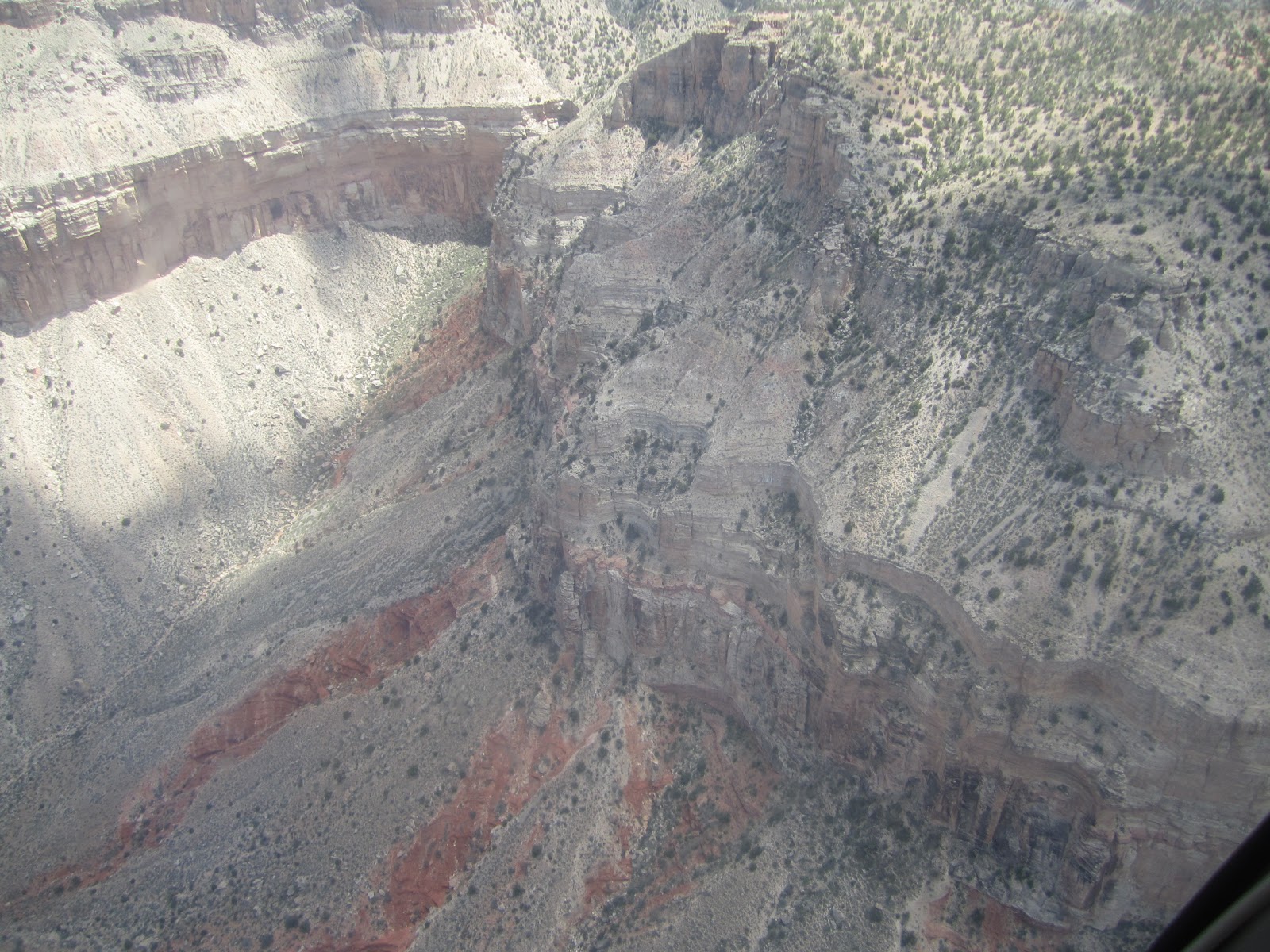 |
| A bird's-eye view from the helicopter |

 |
| On the Esplanade on my second day as part of this search |
 |
| My teammate, Steve, searches on the Esplanade. |
SAR Ops: From Classroom to Call-Out

Also the first to show up, I found a note on our coordinator's office door, saying he'd gone to the main Sheriff's Office building—something about picking up information regarding the subject's recent cellphone activity—so I waited. I wasn't sure what the procedures were for our team's ops volunteers as opposed to what I usually do when I arrive for a regular call-out. But two, more experienced ops leaders walked in within minutes and put me to work. Then our coordinator returned and gave us a short briefing.
While I shouldn't... well, can't give many details about the search (I have to remind myself of that sometimes), I can say it was fun (probably politically incorrect but true) coming up with various scenarios and working on plans for the search.
Shortly after our SAR coordinator had briefed us on the situation, I'd been instructed to call one of our volunteers who lives in the area of this search, which was a good distance from our base in Flagstaff. This searcher is often notified directly when there's SAR activity in his neck of the woods, so he can get a head start as he did this time, heading out to meet with the RP (reporting party) and drive some roads in the area. He knows those roads well.
Next, I helped prepare a briefing packet for the initial response, and then several of us leaned over maps spread out on the conference room table, at times our heads nearly touching. Cellphone information was plotted on those maps, fingers followed contour lines and Forest Service roads, distances were measured, and scenarios were hashed out and re-hashed.
Not long before the general call-out was made to the rest of the team, two of the ops leaders, also regular members of the unit like I am, left for the search area. They would eventually rendezvous with our volunteer already there and assist with the "route and location search," which is what we're calling a hasty search nowadays, based on what we'd come up with as the most likely places the subject might be found.
I'm happy to report that the information gathered in the initial investigation, combined with the scenarios and plans formulated back at the SAR building and the quick response from our volunteer in the area, the subject was located and in good condition.
I was also able to attend the next call for ops leaders just days later to discuss a potentially very complex search in remote, rugged terrain. I didn't say much at that meeting, except when asked directly for my opinion, but I found it really interesting to listen the other, more experienced ops leaders and law enforcement/SAR personnel talk about scenarios, logistics for getting a large amount of specialized gear and personnel into the area, and weigh the risks against the quality of the information—or lack thereof—that was available so far.
Yep, I really find this SAR Ops stuff fascinating. Although I already knew quite well what goes on behind the scenes of a SAR mission and what's involved in more extensive, multi-operational-period and multi-agency missions, the ops classes I've taken have really reinforced that there's so much more to SAR than people just showing up to wander around, looking. The classes also showed how important it is that as many people as possible be trained to work within the Incident Command System, particularly for large, complex situations. This training also drives home the message that taking the time to properly investigate and plan a search, as opposed to just rushing out to the field, can really save time in the end and get the missing subject found sooner than later.
 |
| Both paid and volunteer SAR professionals work with the WIN-CASIE computer program during the Inland Search Management class, held in Flagstaff, Arizona |
**********
And in other team news...Our own Cindy McArthur received word from NASAR Canine Committee Chair, Ann Christensen, that her dog, Nitro, who passed away earlier this year, has been selected to receive the NASAR Canine of the Year award. Christensen stated, "This year, we were very fortunate to have a number of deserving canines nominated for this award and the competition this year was stiff and the decision difficult," but, in the end, Nitro was chosen for his years of excellent service to the SAR community.
Nitro will be honored and the award presented at the 2012 NASAR Conference Closing Award Ceremony on Saturday, June 9th at Lake Tahoe.
Congratulations, Cindy and Nitro!
And speaking of SAR canines...
The 2nd annual Arizona K9 SAR Conference, held here in Flagstaff, AZ, just concluded this past Sunday and, once again, was a great success, with more than 60 handlers and their dogs attending. We're looking forward to more of these educational training events in the future.
SAR While I Was Away
While I know our SAR coordinator and assistant coordinators have been plenty hard at work, in part with calls that ended up being resolved by deputies and means other than us volunteers, it has been rather slow when it comes to call-outs. Not that that's a bad thing, of course! But there have been some call-outs lately, all of which occurred while I was either in a SAR-related class (Incident Command System 300) or while I was away for eight blissful days at Yosemite National Park.
First, there was the call for another body recovery below Midgley Bridge in Sedona. I say "another" because, sadly, we tend to have several of these calls each year. All but one that I know of since I've been on the team have been suicides, while one near (but not under) the bridge was an accidental fall. In this latest case, it was a 60-year-old woman who had died. See Woman's Body Found Below Midgley Bridge in the Arizona Daily Sun. Several of my teammates responded to this call.
Then there was a technical rescue call for a young man who'd fallen into the Little Colorado River Gorge and broken his leg. After a long wait due to the remoteness of the area and some misinformation from the reporting party about the victim's location, the injured man was eventually short-hauled by helicopter to the rim and then flown to the hospital.
As I was on my way back from the Yosemite trip, a SAR call came through about a missing mule-rider in the Schultz Pass area of the San Francisco Peaks who may also have been injured. The call was for both general (ground) and mounted SAR. I later found out that the missing party showed up at home on his own.
After returning home myself, I happened upon a news story stating that search and rescue volunteers and deputies had been sent to look for a self-reporting lost hiker on Mount Elden, who told the 9-1-1 dispatcher that he'd hurt his ankle and thought he was being stalked by wild animals. Since I never received a call-out message, I'm assuming that certain volunteers who live near Mt. Elden were called directly to make the initial response. Read Drunken Hiker Asks for Rescue to find out how that mission was resolved.
And that's about all the SAR volunteer activity I know of, other than some team trainings, while I was away. In about a week, I'll be tied up again, this time in a five-day Inland Search Management class. Having completed the ICS-300 class last month and some other prerequisites, I've now been added to the ops list and will be called out if operations leaders are needed to prepare for a mission. So, this next class will teach me more about SAR operations and help me contribute. I'm excited!
Have I mentioned lately that I love SAR?
First, there was the call for another body recovery below Midgley Bridge in Sedona. I say "another" because, sadly, we tend to have several of these calls each year. All but one that I know of since I've been on the team have been suicides, while one near (but not under) the bridge was an accidental fall. In this latest case, it was a 60-year-old woman who had died. See Woman's Body Found Below Midgley Bridge in the Arizona Daily Sun. Several of my teammates responded to this call.
 |
| Little Colorado River Gorge |
As I was on my way back from the Yosemite trip, a SAR call came through about a missing mule-rider in the Schultz Pass area of the San Francisco Peaks who may also have been injured. The call was for both general (ground) and mounted SAR. I later found out that the missing party showed up at home on his own.
After returning home myself, I happened upon a news story stating that search and rescue volunteers and deputies had been sent to look for a self-reporting lost hiker on Mount Elden, who told the 9-1-1 dispatcher that he'd hurt his ankle and thought he was being stalked by wild animals. Since I never received a call-out message, I'm assuming that certain volunteers who live near Mt. Elden were called directly to make the initial response. Read Drunken Hiker Asks for Rescue to find out how that mission was resolved.
And that's about all the SAR volunteer activity I know of, other than some team trainings, while I was away. In about a week, I'll be tied up again, this time in a five-day Inland Search Management class. Having completed the ICS-300 class last month and some other prerequisites, I've now been added to the ops list and will be called out if operations leaders are needed to prepare for a mission. So, this next class will teach me more about SAR operations and help me contribute. I'm excited!
Have I mentioned lately that I love SAR?
Time to Learn Some SAR Ops

Now that I'm in my fifth year with Coco SAR, I'm eligible to begin training for SAR ops (ops = operations). I'm pretty excited about this because I love that part of search and rescue. I look forward to helping with things like mapping out and planning a search, allocating resources and personnel, directing SAR members as they show up for a mission as to what needs to be done and what gear needs to be loaded, and assisting with whatever else the coordinator might need when preparing for a mission.
On Tuesday, March 13–15, I'll be taking the Intermediate Incident Command System (ICS) class, which will cover topics such as transfer of command, unified command functions in a multi-jurisdictional or multi-agency incident, ICS forms, resource management, inter-agency mission planning and procurement, and ICS staffing and organization to include reporting, working relationships and information flow.
******
The way it's working these days with our team is that, when the coordinator is contacted about a SAR call, he'll do some initial investigation and then, if necessary (depending on the type of mission it is), call out just those members qualified to help with operations. Whichever "ops leaders" are available at that stage respond to the SAR building to assist. Then, when ready, the coordinator will do a general call-out for the rest of the team, just the technical rescue team, or even specific members with specific skills as the situation may warrant.
Other than the paid coordinators, SAR ops folks are all volunteer members of team. Many are also members of the tech team, and one or two are mounted unit members. Some of those who help with ops have been on the team for many years—more than 25 years in one case—and have taken many different operations courses. I'm looking forward to that type of training, myself.
Sometimes, ops leaders and the coordinator are able to resolve a situation, often with the help of deputies on scene or over the phone with a lost subject, before a general call-out is made, so other volunteers are able to keep doing what they're doing (like sleeping, for one thing) and don't know about the situation until it's discussed at a monthly meeting. It's amazing how many times the coordinator has been "just about to push the button" for a general call-out when the subject has been located or assisted back to safety or a known location by phone. That saves the rest of us a lot of interrupted activities and unnecessary responses. Saves money too, not to mention time for the person/s who needed help in the first place.
Want to know more about Incident Command System training? These classes are part of FEMA's National Incident Management Training Program. Visit the FEMA NIMS Training site.
A Joint Technical Rescue Training with Border Patrol
That was fun! And it was a challenging exercise, too.
Members of Borstar (which stands for Border Patrol Search, Trauma, and Rescue) out of Tucson invited our technical rescue team to join them for some training in Sedona. They'd come up from southern Arizona on Tuesday to work on wilderness survival and high-angle rescue skills, setting up camp in a beautiful spot overlooking red rock country.
On Wednesday morning, those of us from Coconino County Sheriff's Search and Rescue who were available to participate drove down to meet them, and after introductions were made around their morning campfire and breakfast and coffee were consumed, we moved to the site of the day's tech training: the canyon at Midgely Bridge.
The goal for the day was to set up a high line across the canyon, then do some evolutions with a rescuer on the line, sending that brave soul out to the middle of the canyon, lowering and then raising the rescuer, and then hauling him or her back to one side of the canyon or the other. (I heard some onlookers refer to what we were setting up as a "zip line," but that's something quite different. We certainly didn't want to send anyone zipping anywhere.)

The first part of the operation was a real challenge, given that we didn't have one of those guns that shoots rope. (I've not seen one in action yet, but I've heard about this piece of equipment several times—every time we have to haul rope from one side of a canyon to another.) Once the rope, the track line, had been secured on the "near side" of the canyon, a Borstar member rappelled to the bottom, brought the rope across, and hooked it up to a line sent down from the "far side," so the other end of the rope could be raised and anchored over there. Problem was, there were trees in the way, and the rope had to clear those trees. And it was a lot of rope. The canyon was just shy of 300 feet from rim to rim.
No one was in a big rush, but it took quite a long time just to get the rope strung across the canyon. Then came the task of setting up the anchors, the artificial high directionals on both sides, the tag lines, and the hoist line. Issues were discussed (i.e., the angle of the monopod and guiding lines), and the teams on either side hiked around to the opposite rim via the bridge to inspect the other team's setup before any evolutions took place.
Finally, it was time to send someone across, down, up, and over. Some challenges were had along the way, but in the end, everything was done safely and successfully.
Here are some more photos from our fun day of training. (Some of my teammates went back to Sedona for a second day of joint training with Borstar.)...
Members of Borstar (which stands for Border Patrol Search, Trauma, and Rescue) out of Tucson invited our technical rescue team to join them for some training in Sedona. They'd come up from southern Arizona on Tuesday to work on wilderness survival and high-angle rescue skills, setting up camp in a beautiful spot overlooking red rock country.
On Wednesday morning, those of us from Coconino County Sheriff's Search and Rescue who were available to participate drove down to meet them, and after introductions were made around their morning campfire and breakfast and coffee were consumed, we moved to the site of the day's tech training: the canyon at Midgely Bridge.
The goal for the day was to set up a high line across the canyon, then do some evolutions with a rescuer on the line, sending that brave soul out to the middle of the canyon, lowering and then raising the rescuer, and then hauling him or her back to one side of the canyon or the other. (I heard some onlookers refer to what we were setting up as a "zip line," but that's something quite different. We certainly didn't want to send anyone zipping anywhere.)

The first part of the operation was a real challenge, given that we didn't have one of those guns that shoots rope. (I've not seen one in action yet, but I've heard about this piece of equipment several times—every time we have to haul rope from one side of a canyon to another.) Once the rope, the track line, had been secured on the "near side" of the canyon, a Borstar member rappelled to the bottom, brought the rope across, and hooked it up to a line sent down from the "far side," so the other end of the rope could be raised and anchored over there. Problem was, there were trees in the way, and the rope had to clear those trees. And it was a lot of rope. The canyon was just shy of 300 feet from rim to rim.
No one was in a big rush, but it took quite a long time just to get the rope strung across the canyon. Then came the task of setting up the anchors, the artificial high directionals on both sides, the tag lines, and the hoist line. Issues were discussed (i.e., the angle of the monopod and guiding lines), and the teams on either side hiked around to the opposite rim via the bridge to inspect the other team's setup before any evolutions took place.
Finally, it was time to send someone across, down, up, and over. Some challenges were had along the way, but in the end, everything was done safely and successfully.
Here are some more photos from our fun day of training. (Some of my teammates went back to Sedona for a second day of joint training with Borstar.)...
 |
| One of my teammates helps Borstar members put together the monopod. |
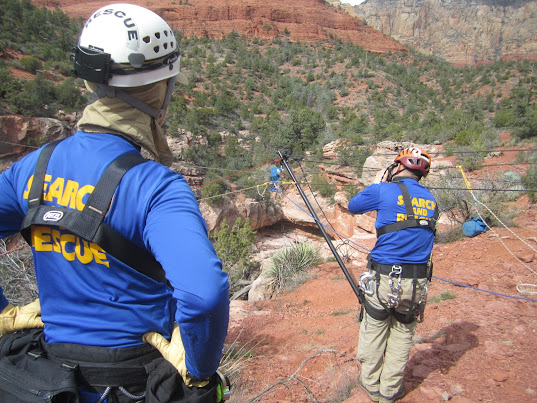 |
| Getting some good shots of the system. |
 |
| Putting together the final touches, like the big Kootenay pulley on the track line. |
 |
| A rescuer is sent out over the canyon. |
 |
| The rescuer is lowered mid-canyon, then raised and hauled to the other side. |
A Happy Surprise in Waterholes Canyon

Once upon a time, there was a man in a canyon. Well, not just in a canyon, stuck in a canyon. This was a very deep and narrow canyon, and the man had been stuck down there for four days and three nights. Three very cold nights, that is, with little to protect him from the elements but a thin jacket and leaves he stuffed in his shirt. A winter storm had visited the area while he was down there, alone.
The man, a traveler from Europe, had run out of water in his Camelbak, probably on the first day. He had no food. He'd injured his left ankle, which was severely swollen, and had bad rope burns on his hands. By the fourth morning, he'd given up hope and "made peace," he later said. He knew he would not survive another night.
But he did! Thankfully, the cards were in his favor, as was his own strength, so he spent that fourth night in a warm bed instead of freezing, thirsty, hungry, and possibly dying in that canyon.
The man had entered the canyon on Friday. His flight home left from Las Vegas without him on Saturday. (Good thing it was that soon because no one may have realized he was missing until he missed that plane.) On Sunday, his wife had called for help when her husband failed to return, and that call for help was relayed to the Coconino County Sheriff's Department.
In the wee hours of the morning on Monday, the man's vehicle was located at the top of the slot canyon, in a pull-out along the highway south of Page, Arizona. The search and rescue team was called out at about 4 a.m., and north we went from Flagstaff. It didn't look good for the man we had to assume was somewhere in that big canyon, with many rappels, one about 400 feet in vertical length, between the highway and the Colorado River.
But then things took a turn... for the much better: A deputy walking the rim and calling out in the dark heard a voice answer from below. That great news was quickly relayed to our team as we drove, and the mood changed. Approximate coordinates were called in by the deputy on scene to our coordinator in another vehicle and transmitted from our coordinator to us.
Then our teammate in the passenger seat, an expert canyoneer very familiar with this canyon, plotted those coordinates on the map, knowing it was not possible to pinpoint the man's exact location by voice contact alone. Given a good idea of where he was, however—although he could have been at the top of a rappel or at the bottom—rescue scenarios were hashed out and re-hashed among us. Everything would depend, of course, on the man's actual location in the canyon and his physical condition.
The rescue could not have gone more smoothly. Two of my teammates and a medic from Page Fire Department entered Waterholes Canyon via a known "escape route" not far from where voice contact had been made from the rim. Carrying medical and warm-up gear, extra food and drinks (including some water I'd boiled for hot cocoa), they made their way down and then up-canyon toward the subject.
Meanwhile, the rest of us came up with a backup plan in case the man needed to be raised out of the canyon with a technical rope rescue system. The DPS helicopter had landed, and the pilot and medic stood by.
Regarding the helicopter crew, they'd flown over the canyon and spotted the man, but they would not have been able to short-haul him from his current location. The canyon was too deep and narrow. And given the fact that the man was standing and waving his arms, the added risk of performing a short-haul, had one even been possible, was deemed unnecessary. The man would either be assisted out by rescuers under his own power, or he would be "packaged" in either a litter or a harness and raised out of the canyon with an attendant.
As it turned out, the man, perhaps somewhat aided by adrenaline, was able to tough out his injuries and exit the canyon via the escape route, with the help of the three rescuers. As his head popped up over the rim, we all saw a big smile on his face, and we all smiled, too.
 |
| Joel and Mike get geared up and ready to go into the canyon. |
 |
| Jeff from Page Fire looks down at the deputy on the rim. |
 |
| Rescuers wait for word from those descending to the subject. |
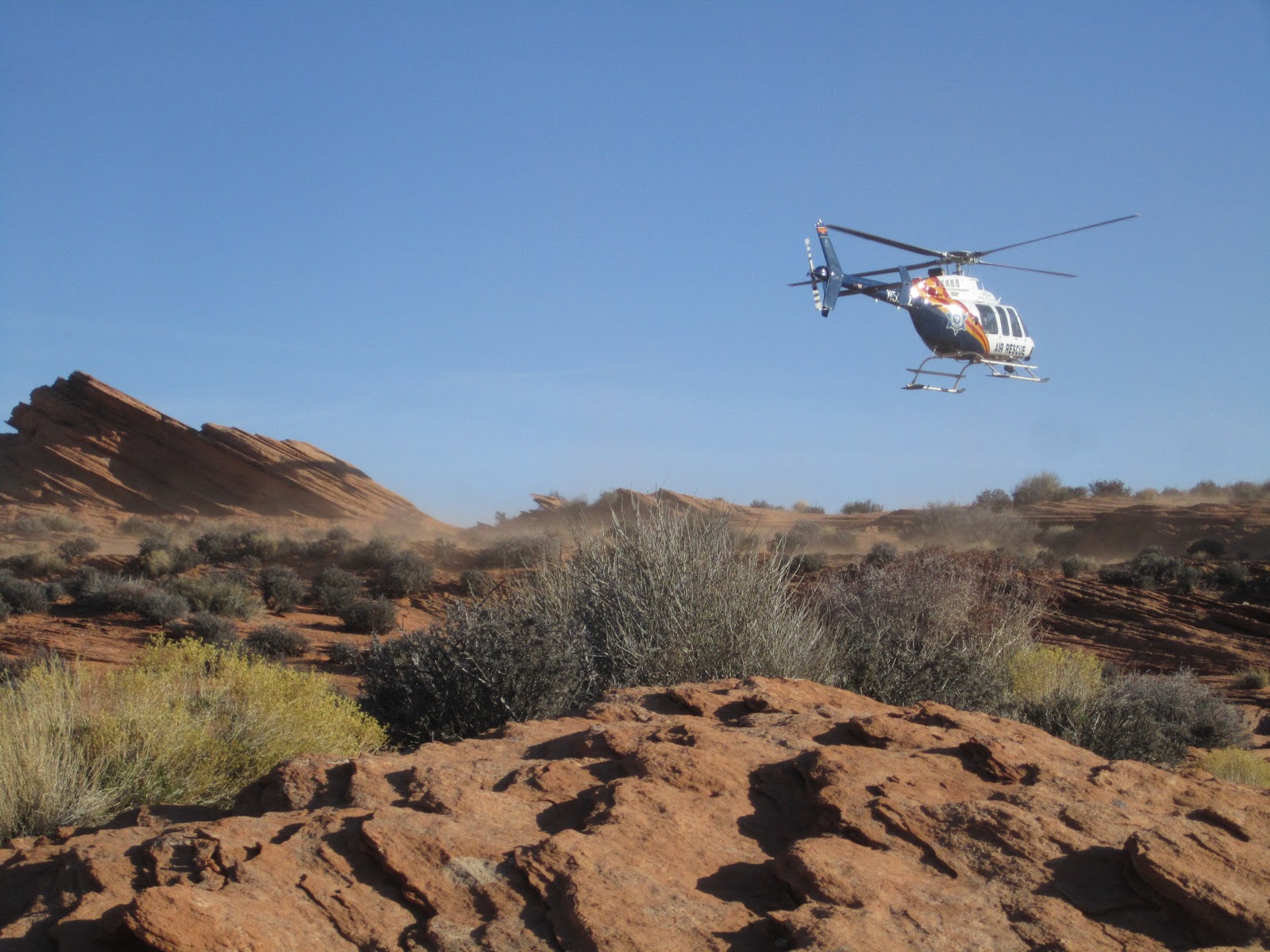 |
| DPS Ranger out of Tucson arrives on scene. |
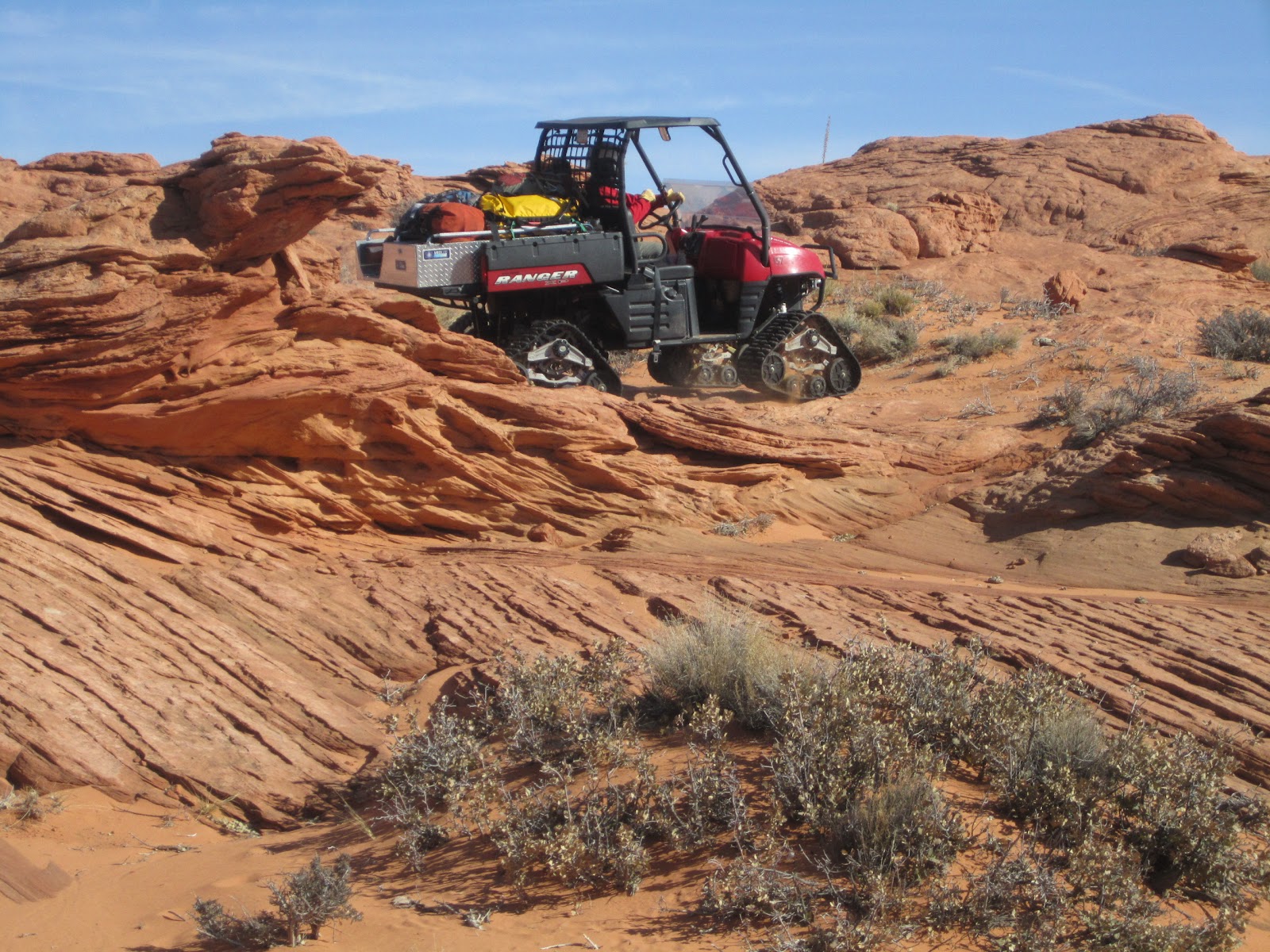 | |
| Our team's Polaris UTV with Mattrax is very useful in this rugged terrain. |
******
There was a mission in Meadow Canyon, a moderately technical canyon south of Flagstaff. This was a search for two overdue canyoneers. (Canyon rescues seem to be... rather, I would say are on the increase in the area.) I was unable to respond to this call, which came in the middle of the night, because I couldn't leave my sick pup (who's now fine, thankfully). But a teammate gave me the scoop. He said...
"I went on that call last night thinking it would last maybe 6 to 8 hours (I had a job lined up at noon) and instead it lasted 16 hours. A couple guys in their early 40s were overdue from a canyoneering trip. Eight of us tried all night to find roads that would take us to the edge of the canyon but with no luck. The back roads were muddy, icy and snow covered.
"The helicopter saw the subjects' campfire and got their coordinates, but we still couldn't get to them. With daylight, a radio was dropped to them and they claimed they were too tired and cold to go further and were afraid of the almost 100-yard swim in from of them.
"We talked about sending two people in by helicopter to help swim and hike them out but opted instead for a short haul. The chopper was low on fuel, so the subjects were flown just to the rim, and we had to pick them up via UTV and ATV. The road was strewn with boulders, mud and snow, and it took a couple of hours. On the way back, the ATVs got stuck in the snow a number of times. It was a long day, but the subjects were very thankful."
So, good, another happy ending!
******
Need a new read? My novel "I. Joseph Kellerman" (which has nothing at all to do with SAR) is available on Amazon Kindle and in paperback. Thanks for putting up with my blatant plug.
Subscribe to:
Posts (Atom)